
What Is Ad Creative? A Complete AI-Powered Guide to High-Converting Ads in 2026
Learn what ad creative is, why it matters more than targeting, how AI tools are transforming creative production, and a practical framework for building ads that convert.
In digital advertising, ad creative is the actual content that users see: the video, image, headline, body text, and call to action that appears in their feed. While targeting and bidding get most of the technical attention, creative is consistently the largest lever for campaign performance. A strong creative can rescue a mediocre targeting setup, but even perfect targeting cannot save a weak creative.
What exactly is ad creative?
Ad creative encompasses every visual and textual element of a paid advertisement. On platforms like Facebook, Instagram, TikTok, YouTube, and Google, creative includes the primary media asset: a video clip, static image, or carousel, plus the accompanying headline, primary text, description, and display URL. On search engines, creative refers to the ad copy: headlines, descriptions, and sitelinks. On connected TV and programmatic display, creative includes video files, companion banners, and overlay text. The common thread is that creative is the message the audience actually consumes, making it the single most direct lever for influencing click-through rates, conversion rates, and return on ad spend.
Creative is also where brand strategy meets performance measurement. A brand might have a clear positioning and value proposition, but that strategy only becomes measurable when it is expressed in a specific ad that real people see and respond to. This is why creative testing, the practice of running multiple ad variants simultaneously to identify which creative elements drive the best results, is fundamental to modern performance marketing.
Why ad creative matters more than targeting in 2026
Platform algorithms have become so sophisticated at finding the right audience that the marginal benefit of manual targeting tweaks has decreased significantly. Meta's Advantage Plus, Google's Performance Max, and TikTok's Smart Performance Campaign all use machine learning to identify converting audiences automatically. In this environment, creative becomes the primary differentiator. Two advertisers running the same product with similar budgets and the same automated targeting will get vastly different results based entirely on which creative resonates better with the algorithm's audience model.
A 2024 Meta study found that creative quality explains over fifty percent of ad performance variance on their platform. This means that for most advertisers, improving creative output delivers higher ROI than optimizing any other single variable. The implication is clear: teams should invest more in creative production and testing than in audience research or bid strategy optimization.
What makes a high-converting ad creative?
High-converting ad creative follows a repeatable structure regardless of platform or product. First, the hook captures attention in the first one to three seconds by identifying a specific pain point, making a bold claim, or creating curiosity. Second, the body delivers proof: a demonstration, testimonial excerpt, data point, or before-and-after comparison that makes the claim believable. Third, the call to action tells the viewer exactly what to do next: shop now, sign up, learn more, or claim an offer.
For video ad creative specifically, UGC-style formats consistently outperform polished brand productions on social platforms. Viewers trust content that looks like it was made by a real person rather than a marketing department. This has led to an explosion in demand for UGC creators, but also to the emergence of AI UGC platforms that can generate authentic-looking video ads without requiring real creators, shipping logistics, or editing turnaround times.
AI ad creative tools and pricing in 2026
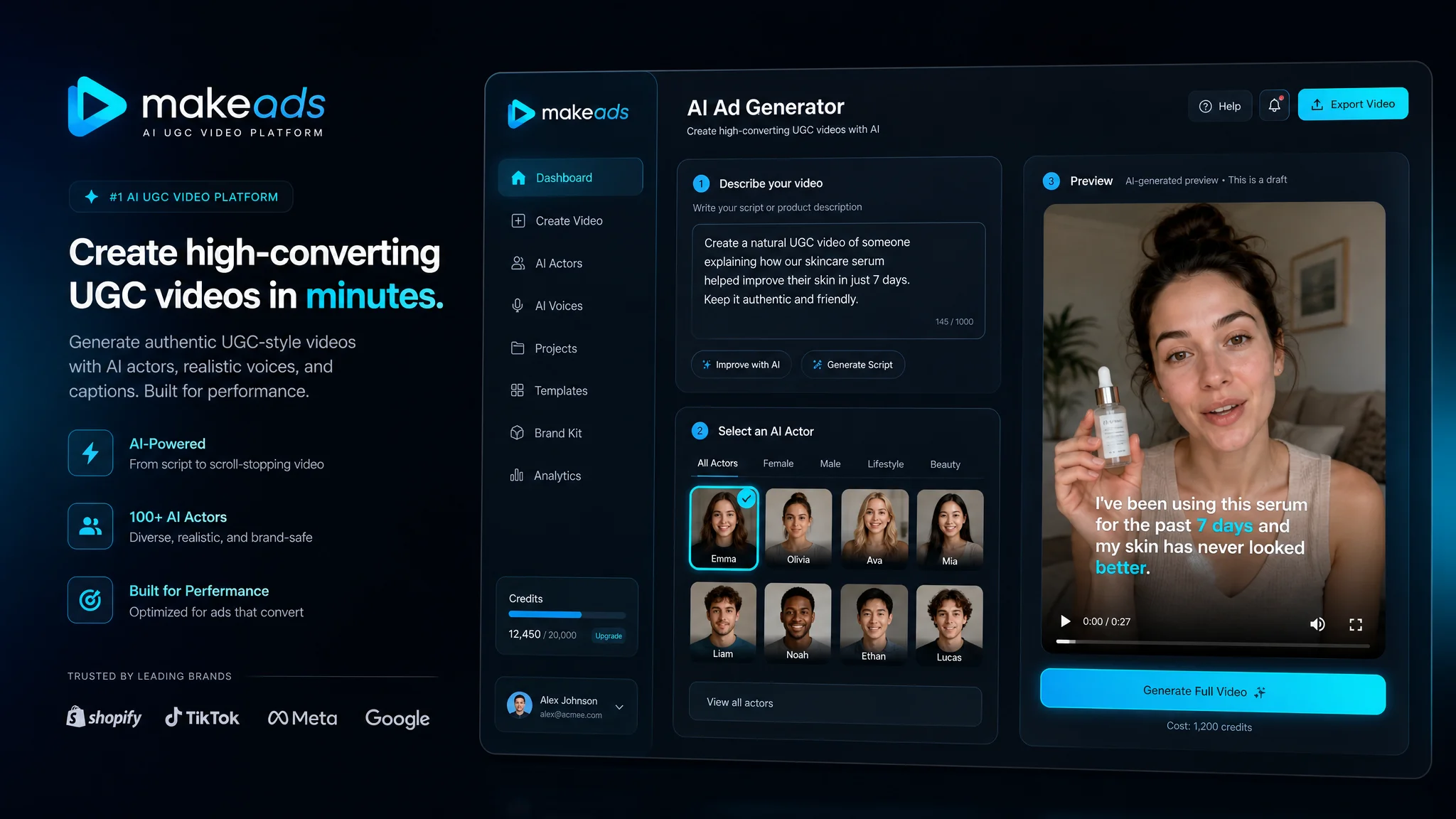
The AI ad creative market has expanded dramatically. Dedicated ad creative platforms like AdCreative.ai offer AI-generated ad visuals and copy with subscription pricing typically ranging from twenty to one hundred fifty dollars per month depending on the number of brands and monthly generations. General-purpose AI video generators like Sora and Kling offer per-credit pricing models. Specialized UGC platforms like makeads combine AI actors, script-to-video generation, dubbing, lip sync, and subtitles into a single production workflow, which replaces the need for multiple separate tools and creator relationships.
When evaluating AI ad creative tools, look beyond the per-generation price. Consider the total workflow cost: how many steps does it take from idea to publishable ad? If you need to use one tool for script writing, another for video generation, a third for subtitles, a fourth for dubbing, and a fifth for export formatting, the integration overhead can exceed the direct software cost. An all-in-one platform that handles the entire chain typically delivers better economics at scale.
Ad text and copy that converts
While video and images get most of the attention, ad text remains critically important. The primary text above a Facebook or Instagram ad sets context for the video and can dramatically influence click-through rates. Good ad text is short, specific, and benefit-focused. Instead of writing "Our product is great, check it out," write "This saved me two hours per video. Here is how." The first is generic brand language; the second is a specific, curiosity-driving hook that makes the viewer want to watch the attached video.
For search ads on Google, ad copy must balance keyword relevance with persuasive messaging. Use numbers when possible because they attract attention in text-heavy search results. Include your primary keyword in at least one headline. Test multiple headline and description combinations to find the pairing that maximizes click-through rate and conversion rate simultaneously.
Sample video ad frameworks to test
If you are building your first ad creative library, start with these proven frameworks:
- Problem-solution: show a specific frustration, then demonstrate how the product fixes it.
- Comparison: show the old way versus the new way with clear visual contrast.
- Testimonial: a person explains their positive experience in their own words.
- Unboxing or first look: genuine reaction to receiving or trying the product.
- How-to: quick tutorial showing the product solving a common task.
For each framework, produce at least three to five variants with different hooks, then let platform data determine which performs best. The teams that win on paid social are not the ones with the most creative budget. They are the ones that test the most creative variants per week and learn fastest from the results. AI creative tools make this testing velocity achievable even for small teams. Platforms like makeads let you generate professional UGC video ads from scripts in minutes, which means you can go from idea to live test in the same day, learn from the data, and iterate again tomorrow.
How to apply this guide in makeads
Use this guide as a practical checkpoint for planning AI UGC videos, comparing creative angles, and deciding which parts of your workflow should be scripted, generated, reviewed, localized, and tested first.
The most useful next step is to translate the advice into one production brief: define the audience, the opening hook, the proof moment, the actor style, subtitle requirements, and the metric you will use to decide whether a video variant is worth scaling.
Related focus areas for this topic include Ad Creative, AI Advertising, Creative Strategy, Performance Marketing. If you are building a campaign library, connect this guide with your pricing assumptions, platform policy checks, and localization plan before creating the final export.