
How Much Can an App Make from Ads in 2026? Complete Revenue Guide
Discover realistic app ad revenue potential in 2026, including CPM rates by category, factors that influence earnings, monetization strategies, and benchmarks for indie developers and established apps.
App ad revenue is one of the most common monetization models, but earnings vary dramatically based on app category, user geography, engagement patterns, and ad implementation strategy. Understanding realistic revenue expectations helps you make informed decisions about your app monetization approach and avoid the inflated claims common in online discussions.
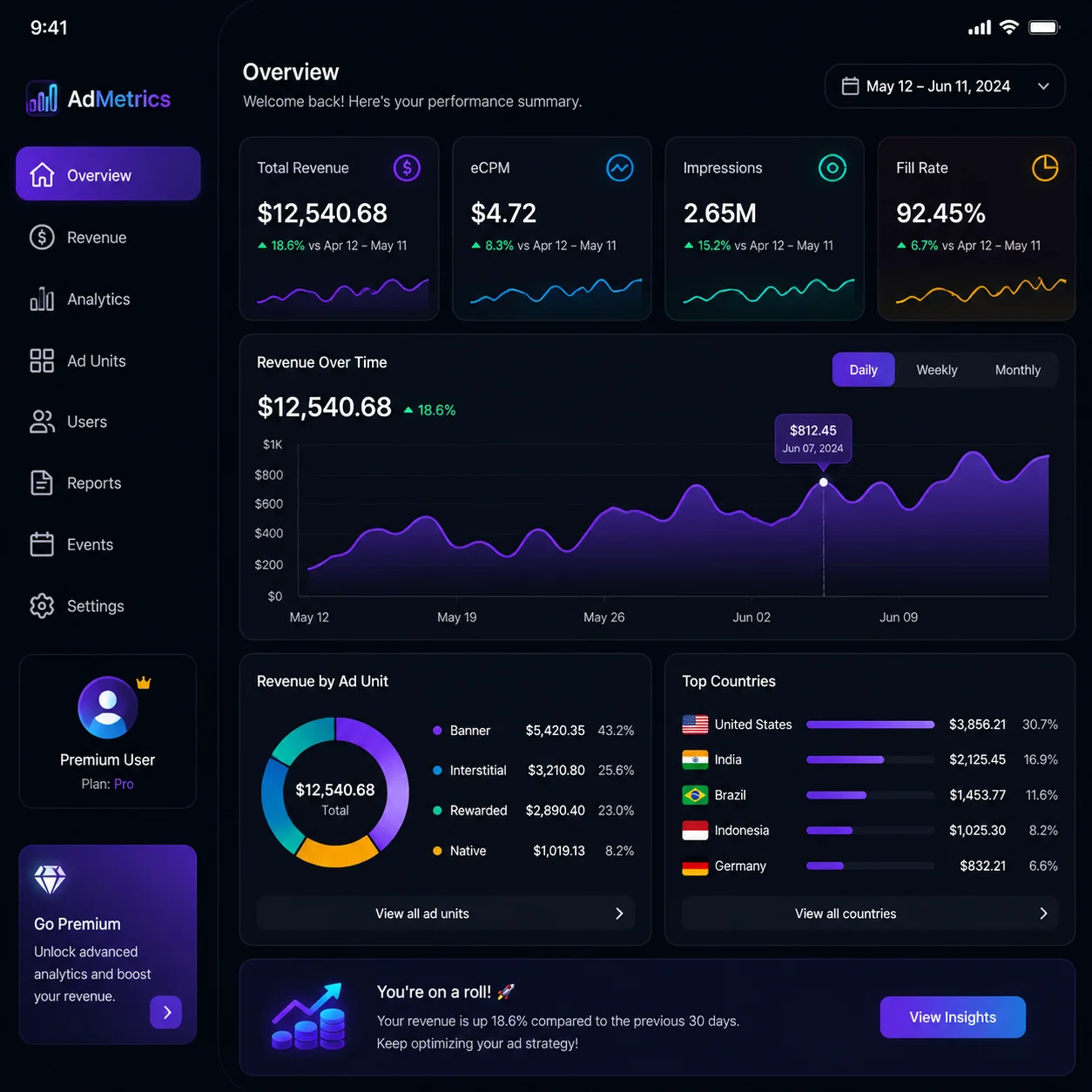
Understanding ad revenue basics
App ad revenue is typically measured using three key metrics. CPM is the cost per thousand impressions, representing how much advertisers pay for one thousand ad views. eCPM is the effective CPM, calculated by dividing total ad revenue by total impressions multiplied by one thousand. eCPM is a more accurate measure of actual earnings because it accounts for fill rates and different ad formats.
Fill rate represents the percentage of ad requests that successfully serve an ad. A 100 percent fill rate means every ad request generates revenue. Actual fill rates typically range from 75 to 95 percent depending on the ad network, app category, and user location. High fill rates in premium markets like North America and Western Europe often offset lower rates in other regions.
Average eCPM rates by app category in 2026
App category significantly influences eCPM rates. Finance and banking apps command the highest eCPM rates, often ranging from ten to thirty dollars in premium markets. Business and productivity apps see eCPM rates between five and fifteen dollars. Social and communication apps typically earn three to eight dollars eCPM. Lifestyle and entertainment apps average two to five dollars.
Gaming apps span a wide range depending on genre and engagement patterns. Casual games average three to seven dollars eCPM. Mid-core strategy games achieve higher rates of eight to fifteen dollars. Hyper-casual games, despite lower per-user revenue, can generate significant total revenue through massive user volume and high session frequency.
Revenue projection by user base size
An app with ten thousand monthly active users in a mixed geographic distribution typically generates between five hundred and two thousand dollars per month in ad revenue. At one hundred thousand monthly active users, revenue ranges from five thousand to twenty thousand dollars monthly. At one million monthly active users, monthly ad revenue can reach fifty thousand to two hundred thousand dollars.
These ranges are broad because geographic distribution dramatically impacts earnings. An app with most users in the United States earns three to five times more per user than an app with users primarily in developing markets. A single user in the United States might generate five to ten dollars in monthly ad revenue, while a user in India generates fifty cents to one dollar.
Ad format impact on revenue
Ad format choice significantly affects revenue per user. Banner ads generate the lowest revenue but are least intrusive. Interstitial ads earn two to five times more than banners but interrupt user experience. Rewarded video ads earn five to ten times more than banners while providing value to users through in-app rewards. Native ads blend with app content and earn premium rates without disrupting user experience.
The optimal ad strategy uses multiple formats in combination. Use rewarded video for high-value voluntary engagement, interstitials sparingly at natural transition points, and native ads for continuous monetization without friction. Banner ads should be used minimally as they provide low revenue relative to the screen space they consume.
Factors that increase ad revenue
User engagement is the strongest revenue predictor. Apps with high daily active user ratios and long session durations earn significantly more per user than apps with infrequent, short sessions. User retention directly correlates with lifetime ad revenue because retained users accumulate impressions over a longer period.
Geographic distribution is the second most important factor. Targeted acquisition campaigns in high-eCPM countries can double or triple revenue without increasing user count. Ad mediation platforms that optimize across multiple ad networks typically improve eCPM by 15 to 30 percent compared to relying on a single network.
Realistic expectations for indie developers
For independent developers, a realistic goal is one to five dollars per thousand daily active users per day. A well-optimized app with five thousand daily active users might earn three hundred to seven hundred fifty dollars per month. Reaching five thousand dollars monthly requires approximately thirty to fifty thousand daily active users with strong engagement.
These figures assume reasonably optimized ad implementation. Poor ad placement, excessive frequency, or low fill rates can reduce earnings by 50 percent or more. Conversely, strong optimization, high engagement, and favorable geographic distribution can double baseline projections.
Comparing ad revenue to other monetization models
Ad revenue is rarely the most profitable monetization model on a per-user basis. In-app purchases and subscriptions typically generate three to ten times more revenue per user than ads alone. However, ads monetize users who never make purchases, capturing value from the entire user base rather than only the converting segment.
The most successful apps use hybrid monetization: ads for non-paying users and premium subscriptions or purchases for engaged users. This approach maximizes total revenue by capturing value from every user segment. Apps with hybrid monetization typically earn two to four times more total revenue than ads-only or purchase-only models.
How to start monetizing with ads
Begin by integrating an ad mediation platform that connects multiple ad networks and automatically optimizes for the highest eCPM. Google AdMob and AppLovin MAX are popular choices. Configure your ad placements based on user experience research. Test different formats and frequencies to find the balance between revenue and user satisfaction.
Track revenue metrics daily and optimize continuously. Monitor eCPM by country and ad network to identify optimization opportunities. Test new ad formats and placements regularly. Keep user experience as your primary consideration because long-term revenue depends on user retention. An app that users love generates sustainable ad revenue. An app optimized for short-term ad impressions loses users and revenue over time.
How to apply this guide in makeads
Use this guide as a practical checkpoint for planning AI UGC videos, comparing creative angles, and deciding which parts of your workflow should be scripted, generated, reviewed, localized, and tested first.
The most useful next step is to translate the advice into one production brief: define the audience, the opening hook, the proof moment, the actor style, subtitle requirements, and the metric you will use to decide whether a video variant is worth scaling.
Related focus areas for this topic include App Monetization, Ad Revenue, Mobile Apps, Business Strategy. If you are building a campaign library, connect this guide with your pricing assumptions, platform policy checks, and localization plan before creating the final export.