
Facebook Video Ad Strategy 2026: Length, Formats, and Creative Best Practices
Learn the optimal Facebook video ad length, how to create high-converting UGC ads for Facebook, dropshipping ad strategies, and tips for reducing cost per result with AI-powered creative production.
Facebook remains one of the most powerful paid social platforms for video advertising, but many advertisers struggle with basic creative decisions: how long should the video be, what format converts best, and how do you produce enough variants to keep campaigns fresh? This guide answers those questions with actionable production strategies for 2026.
How long can a Facebook video ad be?
Facebook technically allows video ads up to two hundred forty minutes in length, but this is almost never the right choice for paid campaigns. The platform's own research and extensive third-party testing consistently show that shorter videos perform better for direct response objectives. For in-feed video ads, the ideal length is between fifteen and thirty seconds. This window is long enough to deliver a clear message with a hook, proof point, and call to action, but short enough to maintain viewer attention.
For Stories and Reels placements, even shorter lengths of ten to fifteen seconds tend to perform best because users scroll through these formats rapidly. For in-stream ads that play before longer content, fifteen to thirty seconds also works well, but you can stretch to sixty seconds if the content is genuinely engaging and the objective is brand awareness rather than conversion. The key rule is to put your strongest message in the first three seconds regardless of total length, because Facebook users scroll past content extremely quickly.
How long should a Facebook ad video be for best performance?
The optimal Facebook video ad length depends on your campaign objective. For conversion campaigns driving purchases, fifteen seconds is the sweet spot. For lead generation, twenty to thirty seconds allows enough time to build trust before asking for an email. For retargeting warm audiences who already know your brand, you can go as short as six to ten seconds because the viewer needs less context. For cold audiences seeing your brand for the first time, fifteen to twenty-five seconds with a strong hook in the first three seconds is ideal.
A practical testing strategy is to create variants at fifteen, twenty, and thirty seconds using the same core script and actor, then measure which length drives the lowest cost per result for your specific audience and objective. Do not assume one length works for every campaign. Audience behavior varies significantly by product category, price point, and market.
Facebook dropshipping ads: what works in 2026
Dropshipping businesses face unique challenges on Facebook. Products often come from suppliers that other advertisers also use, which means ad creative is the primary differentiator. The most successful dropshipping ads in 2026 use UGC-style video content rather than polished brand productions. A video of a real-looking person demonstrating the product, sharing a genuine reaction, or showing a before-and-after result consistently outperforms stock footage or animated product showcases.
For dropshipping specifically, test hooks that highlight a specific problem the product solves rather than generic benefit statements. For example, "I tried five desk organizers and only one actually fit my monitor stand" performs better than "Check out this amazing desk organizer." The hook should create curiosity or recognition that the viewer's problem is about to be solved. Pair the hook with a quick demonstration and a clear call to action. If you are advertising dropshipping products across multiple markets, translate your top-performing ad into local languages using AI dubbing tools to maintain consistency while reaching new audiences.
Facebook ads for photography and creative businesses
Photography businesses, creative studios, and agencies advertising on Facebook should focus on visual proof. Instead of describing your services, show five to ten seconds of your strongest work in a fast-paced reel format. Follow the portfolio showcase with a personal introduction video where you speak directly to the camera about the client problems you solve. This combination of visual proof plus human connection builds credibility faster than either approach alone. For local photography businesses, include location tags and use Facebook's local awareness ad format to target users within your service area.
Facebook ad coupon codes and Black Friday strategies
Facebook occasionally offers ad coupon codes for new advertisers, typically providing fifty to one hundred dollars in free ad credit after spending a minimum threshold. These promotions change frequently and are usually accessible through the Facebook Ads Manager dashboard or partner programs. During Black Friday and holiday seasons, competition on Facebook increases dramatically, which drives up CPMs. To maintain efficiency during these periods, start testing creative variants four to six weeks before the event. Build a library of approved ads, then scale the winners when the holiday window opens. AI-powered creative production tools are especially valuable during these high-volume periods because they let you generate dozens of ad variants quickly without waiting for shoots or editing turnarounds.
How AI UGC platforms reduce Facebook ad production costs
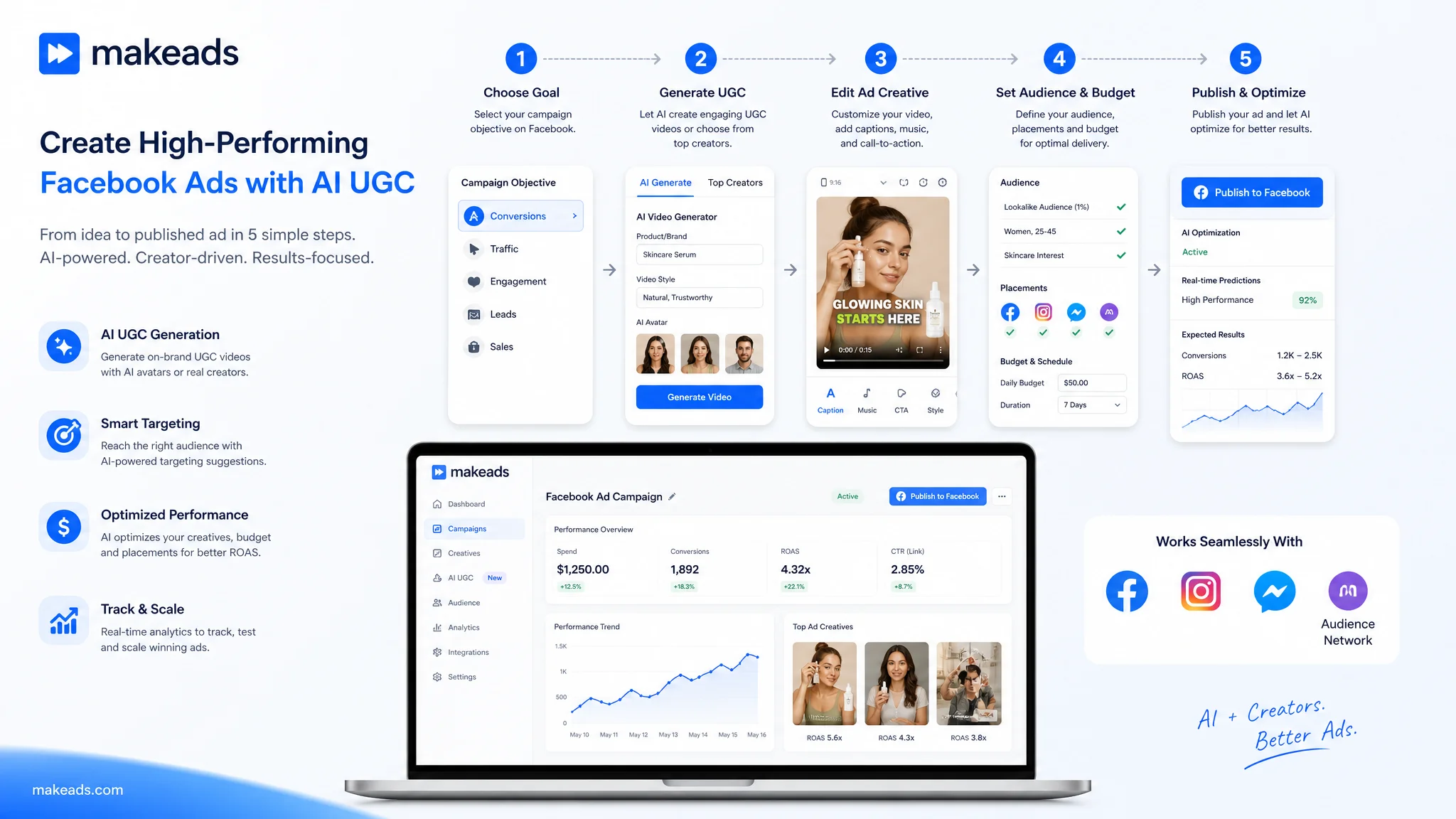
The biggest cost in Facebook advertising is not always the media spend. It is often the creative production bottleneck. Producing enough fresh video variants to avoid ad fatigue requires a constant stream of new content. Traditional production with actors, cameras, and editors is expensive and slow. AI UGC platforms like makeads change this equation by letting you generate professional talking-head video ads directly from scripts. You pick an AI actor from a catalog, write or paste your script, and generate a ready-to-use video ad in minutes. With built-in dubbing and auto subtitles, you can create localized versions for international markets without re-recording anything.
For Facebook advertisers running dropshipping campaigns, multi-product stores, or agency accounts, this dramatically increases the number of creative tests you can run per week while reducing the cost per creative. More variants mean more opportunities to find winning combinations of hook, actor, proof, and call to action. And faster production means you can react to ad fatigue in hours instead of weeks.
- Test video lengths of 15, 20, and 30 seconds with the same script to find your optimal duration.
- Put your strongest message in the first 3 seconds for every Facebook video ad.
- Use UGC-style content rather than polished brand productions for higher engagement rates.
- Translate winning ads into other languages using AI dubbing for international scaling.
- Start testing holiday creative 4-6 weeks before major shopping events.
- Use AI creative platforms to maintain a steady pipeline of fresh video ad variants.
How to apply this guide in makeads
Use this guide as a practical checkpoint for planning AI UGC videos, comparing creative angles, and deciding which parts of your workflow should be scripted, generated, reviewed, localized, and tested first.
The most useful next step is to translate the advice into one production brief: define the audience, the opening hook, the proof moment, the actor style, subtitle requirements, and the metric you will use to decide whether a video variant is worth scaling.
Related focus areas for this topic include Facebook Ads, UGC Video, Ad Strategy, Social Media Marketing. If you are building a campaign library, connect this guide with your pricing assumptions, platform policy checks, and localization plan before creating the final export.