
Reviews of UGC Video Creation Platforms with AI Avatars: How to Compare Them
A review framework for UGC video creation platforms with AI avatars, covering realism, script control, localization, rights, workflow speed, and testing value.
Reviews of UGC video creation platforms with AI avatars can be hard to interpret because demo videos are usually produced under ideal conditions. A useful review should answer a more practical question: can the platform create believable, compliant, localized, and testable videos from the kind of scripts your team actually uses every week?
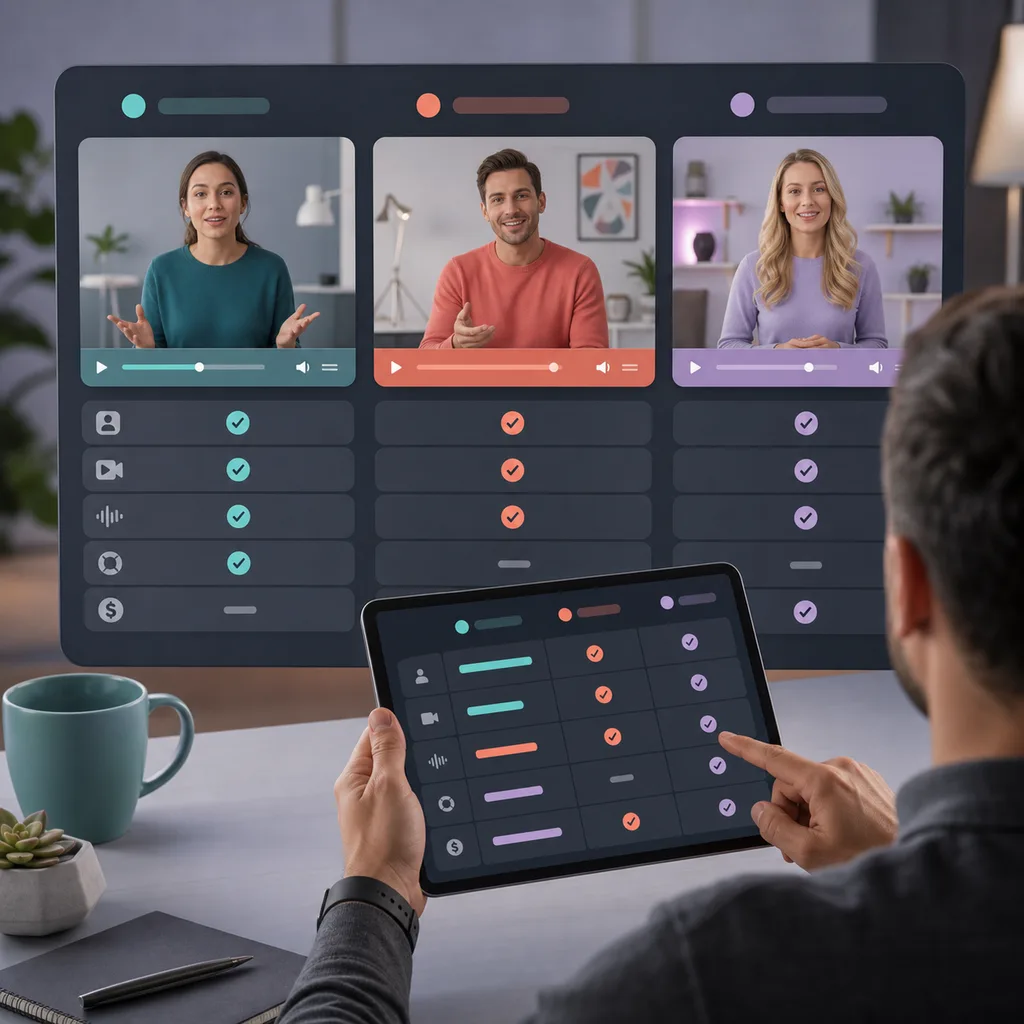
Do not review from vendor samples alone
Vendor samples show what a platform can do when the prompt, actor, lighting, script, and export are all chosen to make it look strong. That is useful, but not enough. Your review should use your own campaign brief. Write one short prospecting script, one retargeting script, and one localization script. Run the same inputs through each platform and compare the outputs side by side. This removes most of the showreel bias.
Score actor realism in context
An AI avatar does not need to fool every viewer in a lab test. It needs to feel credible for the message and placement. Score facial naturalness, lip sync, voice tone, gesture, and eye focus. Then score fit: does this presenter make sense for the product, audience, and claim? A perfect looking avatar with the wrong tone can perform worse than a simpler avatar that feels like the right spokesperson.
Script control and revision speed
UGC platforms are production tools, not just generators. The platform should let you edit the hook, proof, CTA, subtitle lines, and delivery without restarting the whole project. Review how fast a small change takes. Can the team replace the opening sentence and regenerate quickly? Can it keep the same actor and pacing? Revision speed matters because creative testing depends on small controlled changes.
Localization and subtitle review
If the platform includes AI avatars, it should also handle multilingual delivery gracefully. Test at least one translated script. Watch for voice tone, lip sync, phrase length, subtitle density, and whether the CTA still sounds natural. A platform can look excellent in English but become awkward when the sentence length changes in another language. For global campaigns, this is not a secondary feature. It is part of the core review.
Rights and commercial usage
A platform review should always include rights. Ask whether avatar likenesses are licensed for commercial use, where paid ads can run, whether usage is time limited, and what happens if an avatar is removed from the library. Keep the answer in writing. This is not a dramatic legal exercise. It is normal campaign hygiene for any asset that may receive media spend.
A simple scoring model
Score each platform from one to five in six areas: actor quality, script fidelity, revision speed, localization, rights clarity, and performance testing workflow. Add notes about where the platform is strongest. Some tools are better for quick social ads. Others are better for enterprise review trails. The winner is the platform that matches your operating reality, not the one with the most impressive homepage.
Good reviews of UGC video creation platforms with AI avatars are practical and repeatable. Use the same scripts, the same checklist, and the same mobile review process. That approach will reveal which platform can actually support your campaign pipeline.
How to apply this guide in makeads
Use this guide as a practical checkpoint for planning AI UGC videos, comparing creative angles, and deciding which parts of your workflow should be scripted, generated, reviewed, localized, and tested first.
The most useful next step is to translate the advice into one production brief: define the audience, the opening hook, the proof moment, the actor style, subtitle requirements, and the metric you will use to decide whether a video variant is worth scaling.
Related focus areas for this topic include AI Avatars, UGC Platforms, Reviews, Buyer Guide. If you are building a campaign library, connect this guide with your pricing assumptions, platform policy checks, and localization plan before creating the final export.