
What Is UGC? A Complete Guide to User-Generated Content Marketing in 2026
Learn what UGC (user-generated content) is, why it outperforms brand ads, and how AI UGC tools help teams create authentic video ads at scale without expensive creators.
If you scroll TikTok or Instagram for more than a minute, you will notice most high-performing ads do not look like traditional commercials. They look like real people sharing honest opinions. That is user-generated content, and it is the most effective format in digital marketing today.
What is UGC?
UGC stands for user-generated content. It is any content created by real users or customers rather than by the brand itself. In video marketing, UGC usually takes the form of short testimonials, unboxing clips, how-to reviews, or casual product recommendations shot on a phone.
What makes UGC powerful is its authenticity. Viewers trust other people more than they trust polished brand messages. A study by Stackla found that consumers are 2.4 times more likely to view UGC as authentic compared to brand-created content. This trust directly translates to higher engagement, lower cost per click, and better return on ad spend.
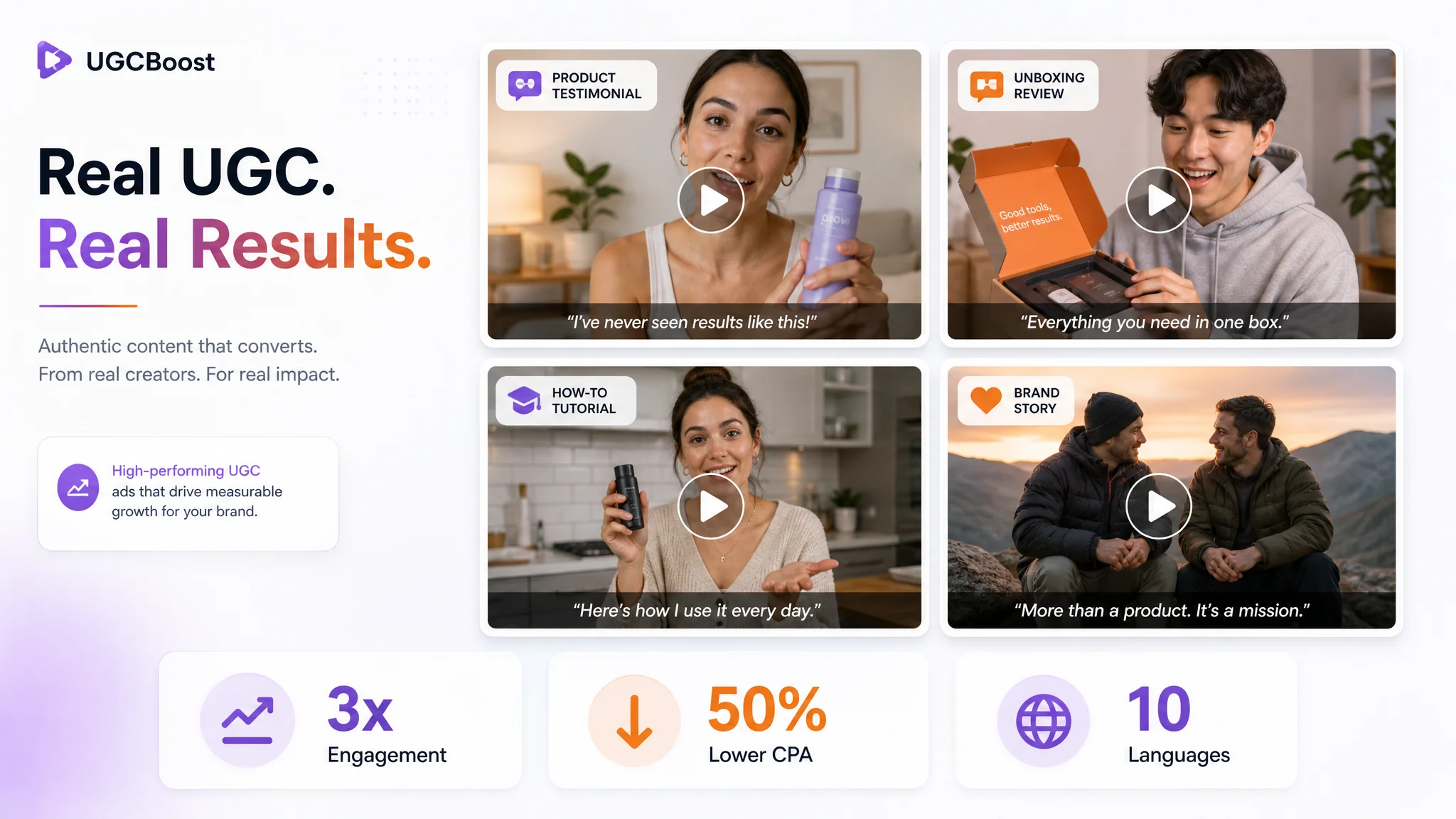
Types of UGC video content
Not all UGC looks the same. Here are the most effective formats for paid social ads:
- Testimonials — A user explains a problem they had and how the product solved it. Best for trust-building and conversion.
- Unboxing — First impression content that shows the product in real hands. Great for physical products and launch campaigns.
- How-to / Tutorial — A short demonstration of how to use the product. Ideal for SaaS, tools, and complex products.
- Before-and-after — Visual proof of transformation. Extremely effective for beauty, fitness, and home improvement.
- Day-in-the-life — Casual integration of the product into a normal routine. Works well for lifestyle and fashion brands.
UGC vs brand content: what performs better?
Brand content can look beautiful, but it often underperforms on social platforms because viewers immediately recognize it as an ad and scroll past. UGC succeeds because it blends into the feed. It looks like content, not advertising.
Here is a direct comparison:
- Production cost — Brand content requires studios, actors, and editors. UGC can be produced with a phone or an AI UGC video generator at a fraction of the cost.
- Speed to market — Brand shoots take weeks. UGC can be created in hours, especially with AI tools that generate talking actors from scripts.
- Trust and engagement — UGC consistently earns higher engagement rates because viewers perceive it as genuine peer recommendation.
- Testing velocity — Because UGC is cheaper to produce, teams can test more hooks, scripts, and angles without breaking the budget.
Why UGC video ads work for ecommerce
Ecommerce brands live and die by their cost per acquisition. UGC video ads consistently deliver lower CPA than polished brand creatives because they reduce skepticism and increase click-through rates.
Here is why UGC is especially effective for ecommerce:
- It shows the product in real-world use, not staged photography.
- It answers implicit buyer questions through demonstration.
- It creates social proof at scale without relying on a single influencer.
- It enables rapid creative testing across audiences and platforms.
How to create UGC videos at scale
The traditional UGC workflow depends on finding creators, shipping products, waiting for footage, and editing the results. This process is slow and expensive. AI UGC platforms like makeads remove most of those bottlenecks.
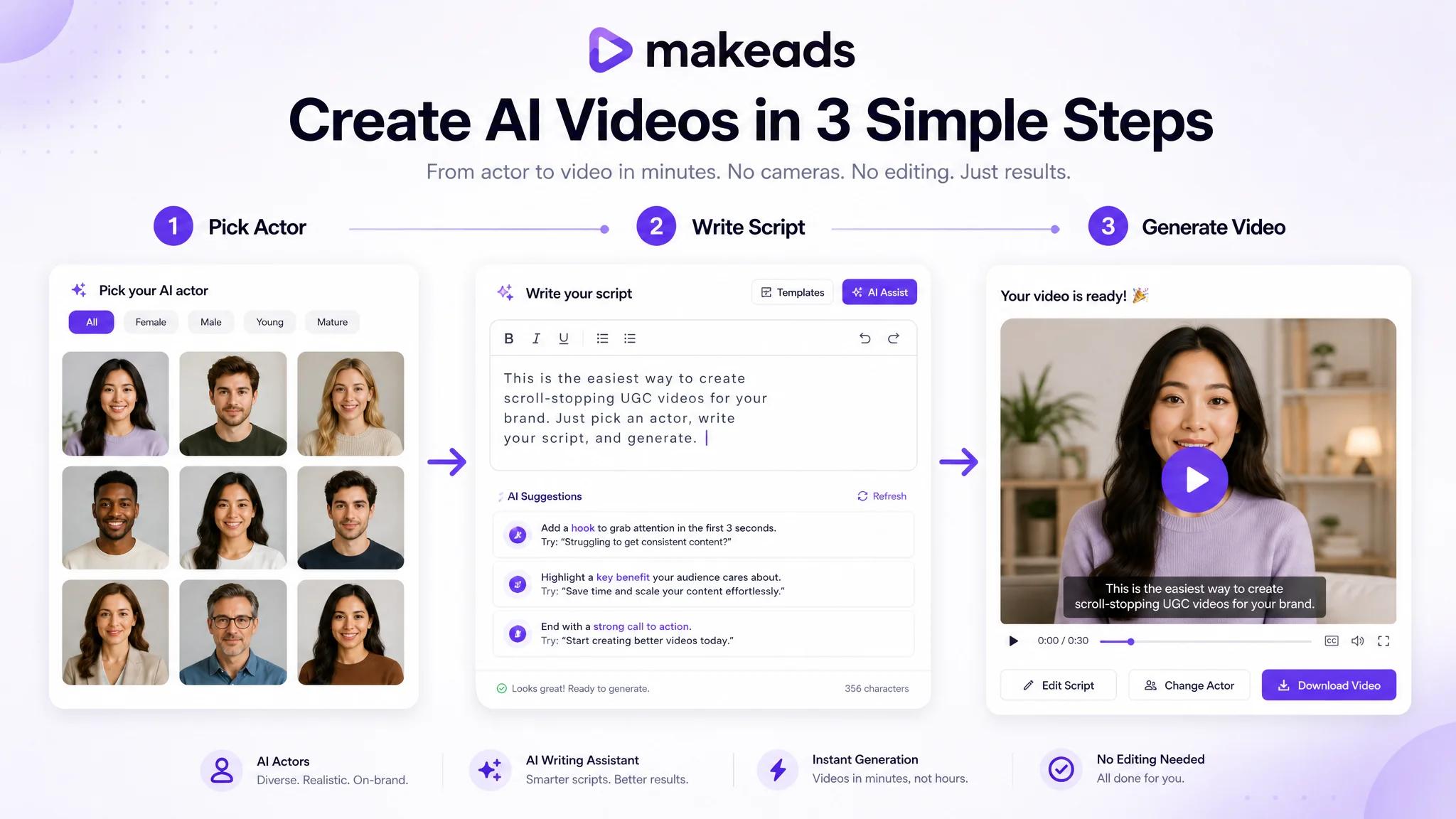
With an AI UGC video generator, the workflow becomes:
- Pick an AI actor that matches your target audience persona.
- Write a script based on a real customer pain point and proof.
- Generate the video in minutes with built-in subtitles and branding.
- Dub into multiple languages for global markets.
- Export and launch across TikTok, Instagram, Facebook, and YouTube.
AI UGC vs traditional UGC: when to use which
Traditional UGC still has value for luxury brands and campaigns where authenticity depends on real identity. But for most ecommerce, SaaS, and direct-to-consumer brands, AI UGC delivers the same performance benefits with far greater speed and control.
AI UGC is ideal when you need consistent output, multiple languages, fast turnaround, and the ability to test dozens of hooks per week. Real UGC is ideal when a known influencer or customer story is central to the campaign concept.
UGC marketing strategy checklist
To build a high-performing UGC marketing system, focus on these fundamentals:
- Define one audience and one promised outcome per campaign.
- Write hooks that sound like spoken advice, not headlines.
- Show proof in the first three seconds.
- Test at least five variants before deciding on a winner.
- Refresh winning creatives before they fatigue.
- Localize top performers into other languages.
- Track creative-level ROAS, not just campaign ROAS.
Key takeaways
UGC is not a trend. It is the dominant format for social video advertising because it respects the viewer's intelligence and fits the native format of the platforms where people spend their time. Whether you source UGC from real creators or generate it with AI actors, the principles remain the same: be honest, be specific, show proof early, and test relentlessly.
If you are ready to produce UGC videos at scale without waiting on creators or studios, makeads gives you AI actors, script-to-video generation, multi-language dubbing, and auto subtitles in one platform.
How to apply this guide in makeads
Use this guide as a practical checkpoint for planning AI UGC videos, comparing creative angles, and deciding which parts of your workflow should be scripted, generated, reviewed, localized, and tested first.
The most useful next step is to translate the advice into one production brief: define the audience, the opening hook, the proof moment, the actor style, subtitle requirements, and the metric you will use to decide whether a video variant is worth scaling.
Related focus areas for this topic include UGC, User-Generated Content, AI UGC, Marketing Strategy. If you are building a campaign library, connect this guide with your pricing assumptions, platform policy checks, and localization plan before creating the final export.