
Kling AI Pricing in 2026: Complete Cost Breakdown for Every Plan
Everything you need to know about Kling AI pricing: subscription tiers, credit costs, free plan limits, and how to calculate your monthly spend for AI video generation at any scale.
Kling AI has established itself as one of the leading AI video generation platforms, particularly for creators focused on short-form social content and marketing videos. But between the free tier, subscription plans, credit systems, and API pricing, understanding what you will actually pay can be confusing. This guide covers every Kling AI pricing option available in 2026.
Kling AI free plan
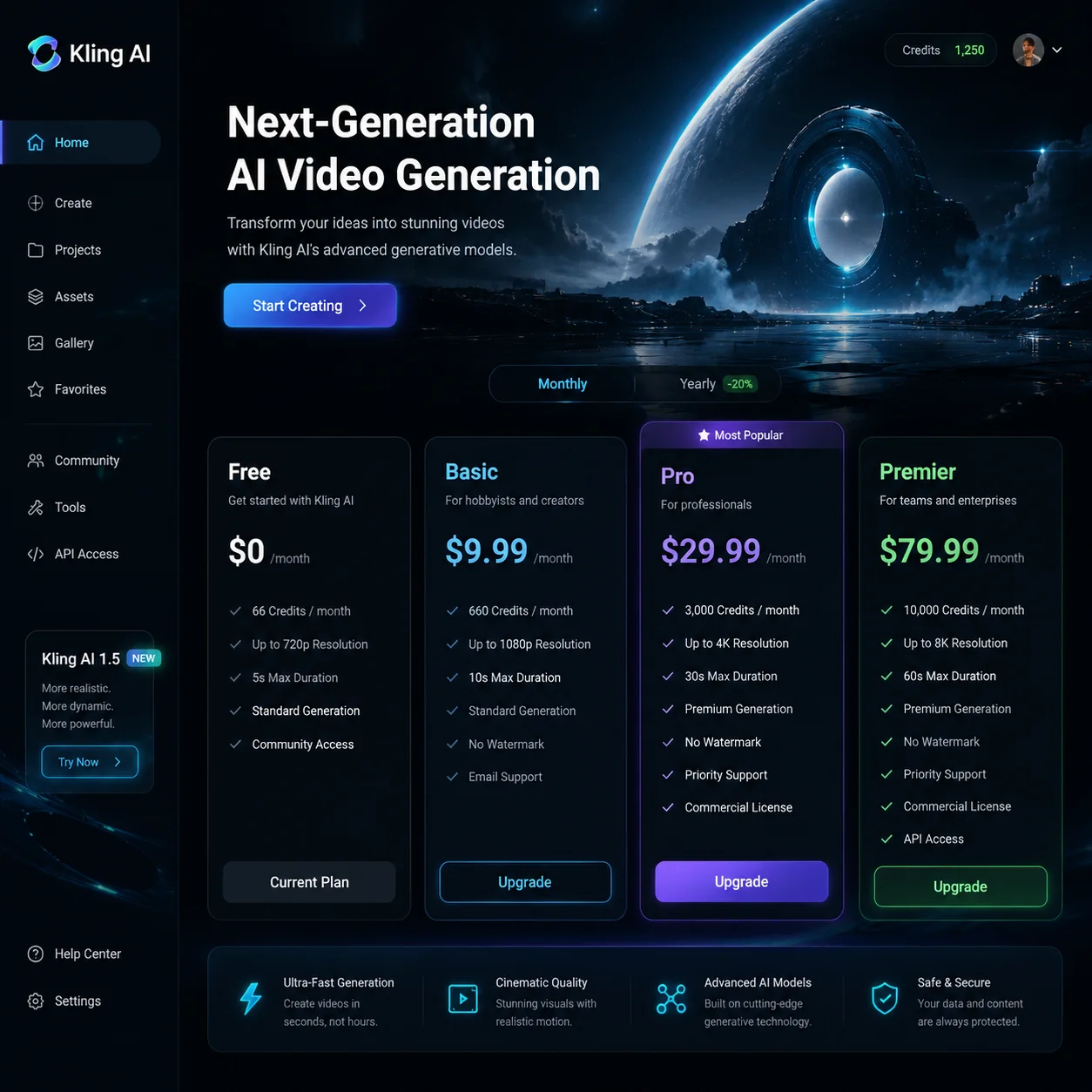
Kling AI offers a generous free plan that gives new users a meaningful chance to evaluate the platform before paying. The free tier typically includes a daily or weekly allocation of generation credits, enough to produce several short videos at standard resolution. Free plan generations often include a Kling AI watermark and are limited in terms of maximum video duration and resolution, but the quality of the output is genuinely useful for testing and prototyping.
For hobbyists, content creators just starting out, or teams evaluating multiple AI video tools, the free plan is an excellent entry point. You can test prompt engineering, explore different visual styles, and decide whether Kling AI's output quality matches your creative needs before making any financial commitment. Just be aware that free-tier generations are deprioritized during high-traffic periods, so queue times can be noticeably longer than on paid plans.
Standard subscription plan
The Standard plan is Kling AI's entry-level paid tier, priced at approximately ten to fifteen dollars per month depending on whether you choose monthly or annual billing. This plan removes watermarks from your generations and provides a larger monthly credit pool sufficient for casual content creation or light professional use. Standard subscribers typically receive enough credits for thirty to fifty short-form videos per month at standard quality settings.
Standard plan users also gain access to faster generation queues and priority support. For individual marketers, small business owners, and solo content creators, the Standard plan usually represents the best value. The credit allocation is sufficient for weekly posting schedules, and the watermark removal is essential for any content that will be published professionally or distributed on behalf of a brand.
Professional and business plans
For agencies, production teams, and high-volume creators, Kling AI offers Professional and Business tiers that scale credit allocations and processing priority substantially. The Professional plan runs around thirty to fifty dollars per month and significantly increases the monthly credit pool. Business and enterprise tiers are custom-priced and typically include dedicated support, API access, team management features, and volume discounts on credit purchases.
Business plan users also receive commercial usage rights that matter for agencies producing content for multiple clients. The licensing terms on lower tiers may restrict certain commercial applications, so teams generating revenue from Kling AI output should verify that their plan includes appropriate commercial licensing. This is especially important for video ad production, where the generated content directly drives client revenue.
Credit system explained
Like most AI video platforms, Kling AI uses a credit-based consumption model. Each generation request consumes credits based on video duration, resolution, and any additional features like motion control or lip sync. A short five-second clip at 720p might cost one or two credits, while a thirty-second 1080p generation with advanced features could consume six to ten credits. Understanding this consumption curve is essential for budgeting, because the credits-per-video ratio changes significantly based on your output specifications.
When you exhaust your monthly credit pool, you can purchase additional credits in packs. The per-credit cost in top-up packs is typically higher than the effective per-credit cost within your subscription allocation, so teams that regularly exceed their monthly cap should consider upgrading to the next plan tier rather than relying on ad-hoc credit purchases.
API pricing for developers
For developers integrating Kling AI video generation into their own applications or production pipelines, the API pricing model differs from the consumer subscription tiers. API access is typically charged on a pay-as-you-go basis per generation request, with pricing scaled by resolution and processing time. High-volume API users can negotiate custom rates, and Kling AI offers dedicated enterprise API plans with guaranteed throughput and SLAs.
The API route is particularly useful for teams building automated video production workflows, such as programmatic ad variant generation, dynamic product video creation, or integration with content management systems. While the per-request cost through the API may be slightly higher than the consumer subscription equivalent, the automation savings and integration capabilities usually justify the premium for production use cases.
How to apply this guide in makeads
Use this guide as a practical checkpoint for planning AI UGC videos, comparing creative angles, and deciding which parts of your workflow should be scripted, generated, reviewed, localized, and tested first.
The most useful next step is to translate the advice into one production brief: define the audience, the opening hook, the proof moment, the actor style, subtitle requirements, and the metric you will use to decide whether a video variant is worth scaling.
Related focus areas for this topic include Kling AI, AI Video Pricing, Video Generation, Creative Tools. If you are building a campaign library, connect this guide with your pricing assumptions, platform policy checks, and localization plan before creating the final export.