
Best AI Video Face Swap Tools in 2026: A Complete Comparison Guide
A detailed comparison of the best AI video face swap tools in 2026, including quality benchmarks, pricing, privacy considerations, and which tool to use for different production scenarios.
AI face swap technology has matured rapidly, moving from novelty filters to professional-grade video production tools. Whether you need to localize talking-head videos for different markets, create personalized marketing content, or produce creative visual effects, choosing the right face swap tool matters for output quality, workflow speed, and legal compliance. This guide compares the leading options in 2026.
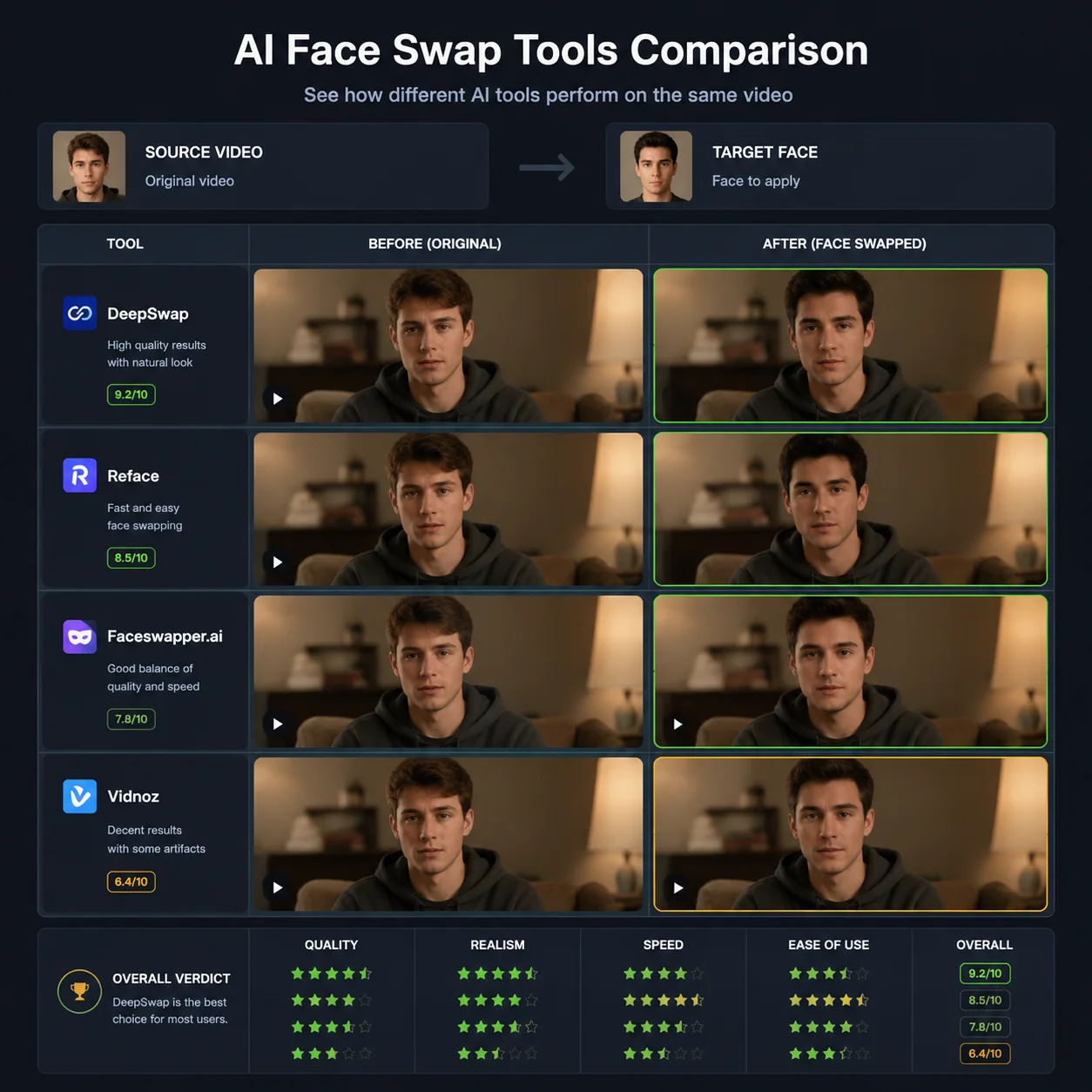
What makes a good face swap tool
Face swap quality depends on several technical factors. Temporal consistency is the most important: a good tool maintains stable face identity across frames without flickering, warping, or identity drift. Lighting matching ensures the swapped face looks naturally integrated into the source scene rather than obviously pasted on. Expression transfer preserves the emotional content of the original performance, which is critical for marketing videos where subtle facial cues affect viewer trust and persuasion.
Beyond visual quality, practical considerations matter. Processing speed determines how quickly you can iterate. Batch processing capability matters for teams producing multiple variants. Output resolution limits affect where the final video can be published. And privacy and data handling policies are critical: any face swap tool you use for professional work should have clear terms about how source images and generated videos are stored and whether they are used for model training.
Top face swap tools compared
Several platforms lead the face swap category in 2026. The major players include dedicated face swap services as well as general AI video platforms that include face swap as part of a broader toolkit. The best choice depends on your specific use case: some tools excel at single-subject talking-head swaps for localization, while others handle complex multi-person scenes or full-body person swaps.
For marketing teams producing UGC-style video ads in multiple languages, platforms that combine face swap with integrated dubbing and lip sync provide the most efficient workflow. Instead of managing separate tools for video generation, face swap, and audio dubbing, a unified platform keeps source assets organized and reduces the handoff points where quality can degrade.
Face swap quality benchmarks
When evaluating face swap quality, test across three dimensions. First, test with front-facing talking-head footage under good lighting: this is the easiest scenario and any competent tool should handle it cleanly. Second, test with profile angles and head turns: many tools struggle when the face rotates away from the camera. Third, test with varied lighting conditions and backgrounds: skin tone matching and edge detection become harder in challenging lighting, and the best tools show clear differences here.
Resolution retention is another key benchmark. Some tools downscale source video during processing and then upscale the result, which introduces softness and artifacts. Tools that maintain native resolution throughout the pipeline produce noticeably sharper output, which matters for professional applications where video quality directly affects ad performance and brand perception.
Privacy and legal considerations
Face swap technology exists in a sensitive legal and ethical space. For professional use, you should only swap faces using source materials for which you have explicit consent and appropriate usage rights. This means obtaining signed release forms from any real person whose face you use as a source, and ensuring your usage complies with platform policies on TikTok, Instagram, YouTube, and any other distribution channel.
Many face swap platforms now include built-in consent verification, content moderation, and usage tracking features. Choose a tool that supports your compliance workflow rather than one that forces you to manage consent and rights tracking entirely outside the platform. This is especially important for agencies managing multiple client accounts where rights management complexity scales with volume.
API integration for developers
For teams building custom video production pipelines, face swap API access is essential. Several providers offer REST APIs for programmatic face swap with configurable quality settings, resolution targets, and processing priority. API pricing typically follows a per-minute or per-request model, with volume discounts available for production-scale usage. When evaluating API providers, test not just the quality of individual results but also the reliability and latency of the API under production load conditions.
How to apply this guide in makeads
Use this guide as a practical checkpoint for planning AI UGC videos, comparing creative angles, and deciding which parts of your workflow should be scripted, generated, reviewed, localized, and tested first.
The most useful next step is to translate the advice into one production brief: define the audience, the opening hook, the proof moment, the actor style, subtitle requirements, and the metric you will use to decide whether a video variant is worth scaling.
Related focus areas for this topic include Face Swap, AI Video, Video Editing, Creative Tools. If you are building a campaign library, connect this guide with your pricing assumptions, platform policy checks, and localization plan before creating the final export.