
Best Free Hook Generators for Video Ads in 2026: Write Better Openings
A practical guide to the best free hook generators and frameworks for writing scroll-stopping video ad openings that actually convert, including AI tools and manual templates.
The first three seconds of your video ad determine whether someone watches or scrolls past. That opening is called the hook, and writing effective hooks at scale is one of the hardest creative challenges in performance marketing. Free hook generators and structured frameworks can help teams produce more testable openings without burning out their writers. This guide covers the best free tools and repeatable methods for 2026.
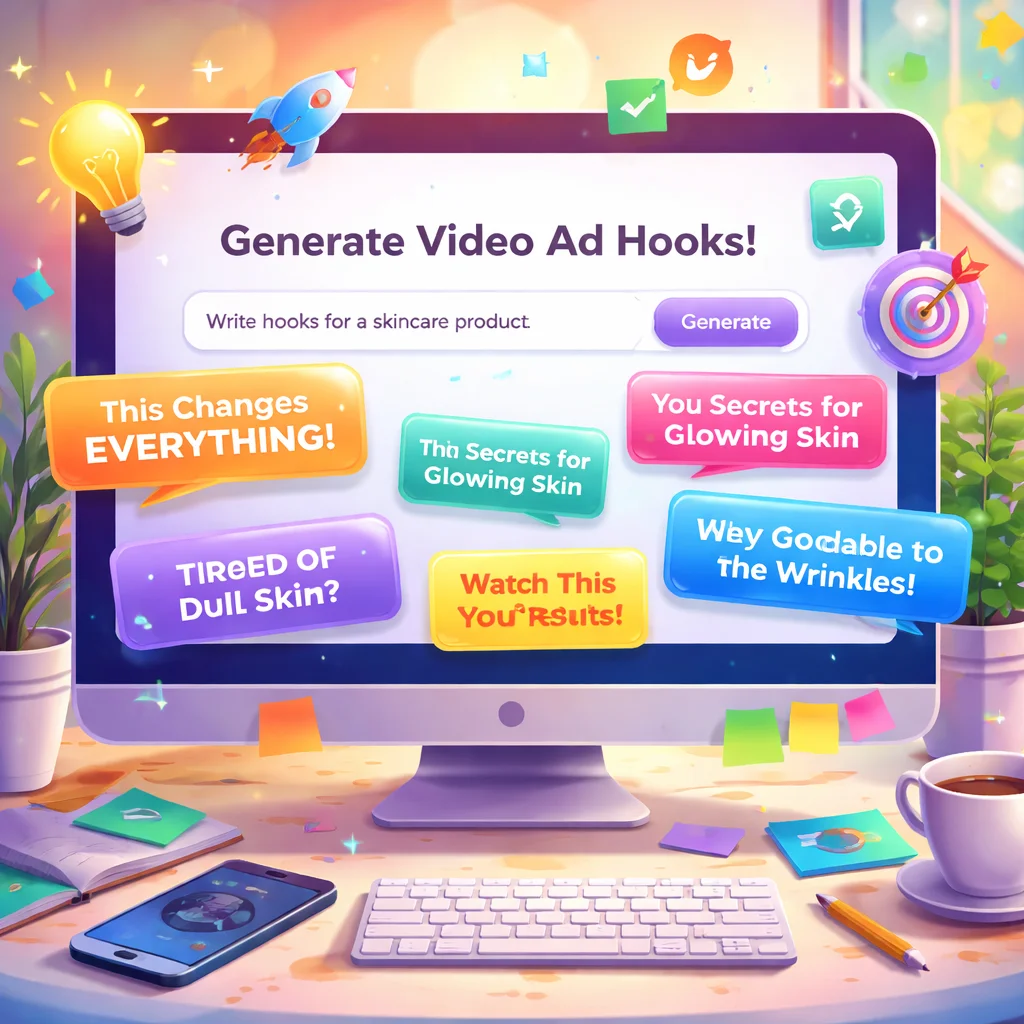
Why hooks matter more than ever
Platform algorithms increasingly reward videos that hold attention in the opening seconds. On TikTok, Instagram Reels, and YouTube Shorts, the first moment determines not just whether an individual viewer stays, but whether the platform shows your video to more people at all. A weak hook means the algorithm stops distributing your content before your message even has a chance to land.
The best hooks do not sound like ad headlines. They sound like a friend interrupting a conversation to share something useful. The most effective hooks create instant context: the viewer understands within one sentence who is speaking, what problem is being addressed, and why they should keep watching. Achieving this consistently requires a structured approach rather than random brainstorming.
The hook matrix framework
Before relying on any generator tool, build a simple hook matrix. List three customer pain points your product addresses. Then list four opening styles: direct problem statement, surprising statistic, personal story setup, and objection reversal. Cross-reference pains against opening styles to generate twelve hook candidates. Not every combination will work, but the matrix ensures you explore angles systematically instead of writing the same three hooks every week.
This framework works because it separates idea generation from execution. The matrix forces writers to consider angles they might naturally skip, and it makes comparing hook performance cleaner because you can isolate whether the pain angle or the opening style drove the result.
Free AI hook generators worth using
Several free AI writing tools offer hook generation capabilities that are genuinely useful for ad creative teams. General-purpose AI assistants can generate hook variations when given a specific product, audience, and pain point. The key to getting useful output is providing enough context: describe your target audience in one sentence, state the main customer problem, identify what makes your product different, and ask for ten hook variations across different emotional angles.
Some dedicated marketing AI platforms offer free tiers with hook generation specifically optimized for ad platforms. These tools are trained on high-performing ad copy patterns and often include platform-specific guidance for TikTok, Facebook, and YouTube. While paid tiers unlock more features, the free versions are usually sufficient for generating initial hook ideas that a human writer can refine.
Manual hook templates that work
The most reliable hook generators are often not tools at all, but templates. Here are five proven hook templates that consistently perform across product categories. The cost revelation: "I was spending [amount] on [problem] until I found this." The objection flip: "Most people think [common belief] about [topic], but here is what actually works." The insider shortcut: "[Audience] hate doing [task]. Here is how to do it in half the time." The consequence warning: "If you are still [doing outdated practice], you are leaving [metric] on the table." The discovery story: "I tried [number] different [solutions] before I found one that actually [result]."
These templates are effective because they each create a specific psychological opening. Cost revelation triggers loss aversion. Objection flip creates curiosity by challenging a held belief. Insider shortcut promises efficiency. Consequence warning creates urgency. Discovery story builds credibility through personal experience. Rotating through these templates ensures your hook testing covers different motivational triggers.
How to test hooks properly
Even the best hook generator is wasted without a proper testing process. When testing hooks, change only the opening sentence while keeping the rest of the video identical. This isolates the hook as the tested variable. Run each hook variant with enough spend to reach statistical significance, typically several thousand impressions at minimum. Track hook rate as your primary metric: the percentage of viewers who watch past the first three seconds. The winning hook becomes your new control, and the next test round introduces new variations against it. Over several testing cycles, this process builds a systematic understanding of which hook approaches work for your specific audience and category.
How to apply this guide in makeads
Use this guide as a practical checkpoint for planning AI UGC videos, comparing creative angles, and deciding which parts of your workflow should be scripted, generated, reviewed, localized, and tested first.
The most useful next step is to translate the advice into one production brief: define the audience, the opening hook, the proof moment, the actor style, subtitle requirements, and the metric you will use to decide whether a video variant is worth scaling.
Related focus areas for this topic include Hook Generator, Ad Copy, Video Marketing, Creative Tools. If you are building a campaign library, connect this guide with your pricing assumptions, platform policy checks, and localization plan before creating the final export.