
HeyGen vs makeads: Which AI Video Platform Wins for Ad Teams in 2026?
A practical comparison of HeyGen and makeads for video ad production. Compare avatar quality, pricing structure, localization, and which platform fits high-volume UGC ad workflows.
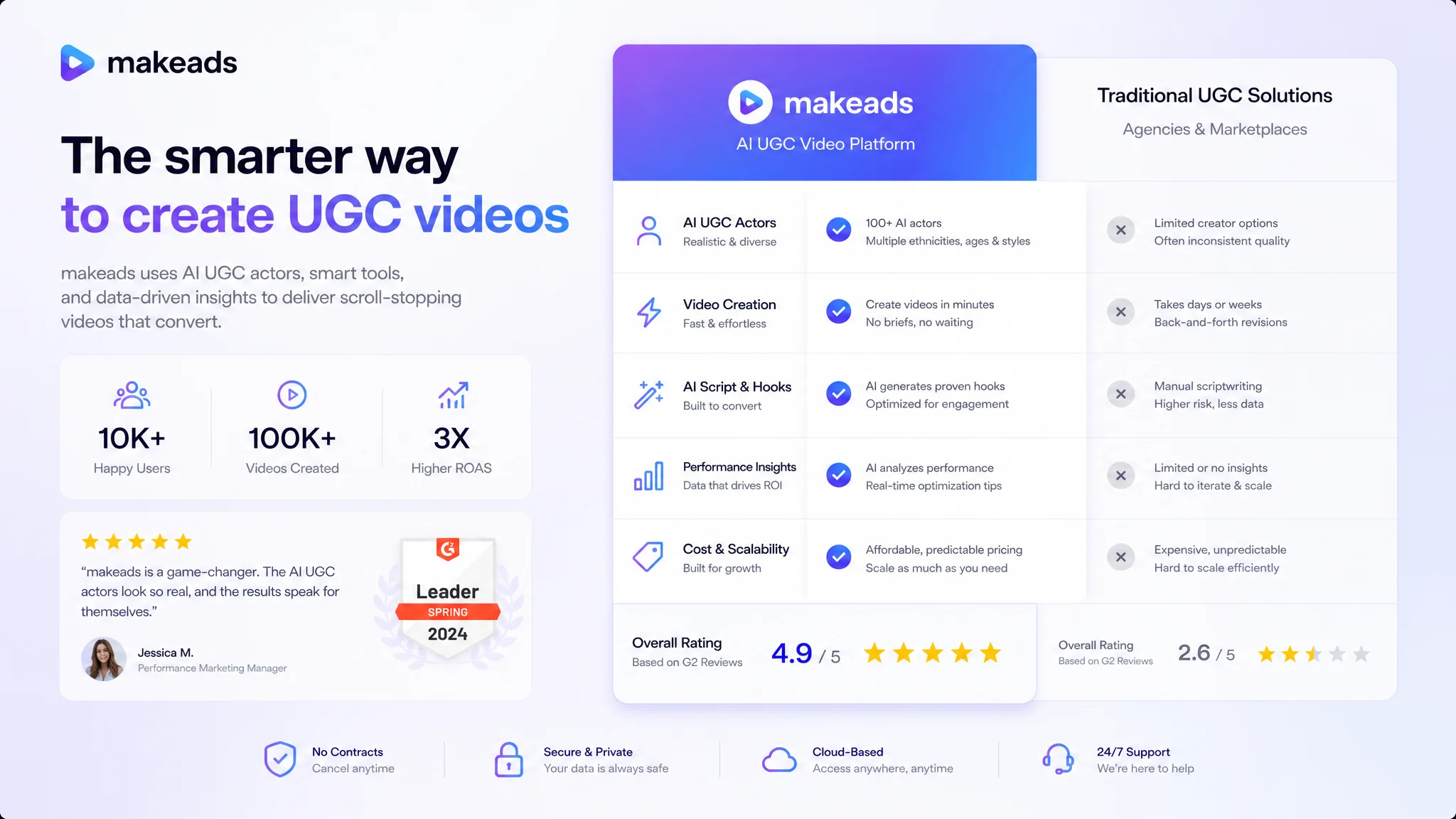
HeyGen and makeads are two of the most discussed AI video platforms in 2026, but they are built for different primary users. HeyGen started as a general-purpose avatar and presentation tool. makeads was built specifically for performance marketing teams producing UGC-style video ads at volume. Choosing between them comes down to what you are actually producing and how many videos you ship per week.
What each platform is optimized for
HeyGen excels at polished, presentation-style avatar video. It is a strong fit for internal communications, product explainers, and corporate content where a single high-quality avatar video needs to look flawless. The avatar library is solid, the rendering quality is high, and the interface is approachable for non-technical users producing occasional videos.
makeads is optimized for the opposite end of the spectrum: teams shipping dozens of video ad variants per week across TikTok, Meta, and YouTube. The workflow assumes you are testing multiple hooks, multiple actors, and multiple languages against each other, and the feature set reflects that. Batch generation, ad-format exports, and direct-response script structures are built in rather than improvised.
Avatar quality and actor library
Both platforms produce convincing talking-head video, but the casting philosophy differs. HeyGen offers a smaller, highly polished set of avatars that work well for brand consistency. makeads offers a larger library spanning diverse ages, ethnicities, and presentation styles, which matters more for UGC ad testing where you need to match the actor to the audience and the product category. For ad teams running audience-segmented creative, a wider casting pool produces more relevant-feeling ads.
On lip-sync and voice naturalness, both platforms have crossed the threshold where casual viewers cannot easily tell the video is AI-generated. The differentiator at this quality level is no longer realism but consistency across volume. When you generate fifty variants, you need every one to maintain the same quality, and that is where a volume-optimized pipeline holds an advantage.
Pricing structure and how it scales
Pricing is where the two platforms diverge sharply for ad teams. HeyGen pricing is credit-based and tends to favor lower-volume, higher-polish usage. As video volume rises, costs can climb quickly, and per-minute or per-video charges make high-frequency creative testing expensive. For a team producing five videos a month, the difference is negligible. For a team producing fifty, it becomes a line item that finance will question.
makeads uses a subscription model designed around ad production volume, which makes weekly creative testing predictable to budget. When the goal is to test more variants rather than produce fewer perfect ones, a flat-fee structure removes the friction of deciding whether each individual video is worth generating. The right model depends entirely on whether your team values polish per video or variants per week.
Localization and multi-language ad workflows
Both platforms support multi-language dubbing, but the depth matters for ad teams expanding into new markets. Translating a winning ad into ten languages used to require ten voice talents and ten re-shoots. With integrated dubbing, a single script becomes ten localized variants in a single workflow. For performance marketers running geo-targeted campaigns, the ability to clone a winning creative across markets without re-production is one of the highest-ROI features of any AI video platform.
Which platform should you choose?
Choose HeyGen if your primary output is presentation-style or corporate video, your volume is low, and you value a polished general-purpose tool. Choose makeads if your primary output is direct-response video ads, your team ships multiple variants per week, and you need a workflow built around creative testing and localization. Many teams end up using both, HeyGen for internal and brand content, makeads for the performance ad pipeline that drives measurable revenue.
How to apply this guide in makeads
Use this guide as a practical checkpoint for planning AI UGC videos, comparing creative angles, and deciding which parts of your workflow should be scripted, generated, reviewed, localized, and tested first.
The most useful next step is to translate the advice into one production brief: define the audience, the opening hook, the proof moment, the actor style, subtitle requirements, and the metric you will use to decide whether a video variant is worth scaling.
Related focus areas for this topic include Comparison, HeyGen, AI Video, UGC Ads, Platform Review. If you are building a campaign library, connect this guide with your pricing assumptions, platform policy checks, and localization plan before creating the final export.