
AI Video Ad Script Generator: Writing Hooks That Convert in 2026
How AI video ad script generators are replacing guesswork in UGC production. Learn the hook frameworks, script structures, and workflows that produce ad scripts actors can actually deliver.
A video ad is only as strong as the script behind it. The actor, the lighting, the editing, and the dubbing all serve the words. Yet scriptwriting is the step most ad teams rush, recycle, or outsource to generalist copywriters who have never written for a talking-head format. AI video ad script generators have closed that gap, turning a brief into a structured, performable script in minutes instead of days.
Why ad scripts are different from other copy
Landing page copy can be skimmed. Email copy can be re-read. A video ad script is spoken aloud, at a fixed pace, with no chance for the viewer to rewind. That changes the rules. Sentences must be short enough to deliver in one breath. Numbers must be concrete because vague claims sound evasive when spoken. The opening line must earn the next three seconds, because on TikTok, Reels, and Shorts the first frame determines whether the viewer stays or scrolls.
Most copy written for text performs badly when read aloud. It is too dense, too formal, and too long between ideas. An AI video ad script generator that is trained on spoken ad performance understands this distinction. It produces sentences built for breath, pacing, and the conversational tone that makes UGC feel authentic rather than corporate.
The three-part structure every ad script needs
A converting UGC ad script has three structural jobs. First, the hook: a single sentence in the first two seconds that stops the scroll by naming a problem, a desire, or a surprising fact the target viewer recognizes instantly. Second, the proof: the section where the script delivers evidence that the product works, usually through a demonstration, a before-and-after, a specific result, or a relatable scenario. Third, the call to action: a clear instruction telling the viewer exactly what to do next and why they should do it now rather than later.
Scripts that fail almost always fail in one of these three places. A weak hook means nobody watches. Weak proof means nobody believes. A weak call to action means nobody acts. An AI script generator that understands ad performance does not just write fluent sentences; it fills each of these three slots with purpose-built content rather than leaving them to chance.
Hook frameworks that actually stop the scroll
The most reliable hooks fall into a small number of proven patterns. The problem hook names a frustration the viewer has right now. The negative hook warns against a common mistake. The curiosity hook opens an information gap the viewer wants closed. The result hook leads with a specific outcome. The contrarian hook challenges a widely held belief. An AI script generator can produce variants across all five frameworks from a single brief, giving you five different opening angles to test against the same audience instead of betting your budget on one.
The mistake teams make is treating the hook as a creative flourish rather than a test variable. The hook is the highest-leverage line in the entire script because it determines how many people ever hear the rest. Generating ten hook variants and testing them in cheap placement before committing to full production is the single most cost-effective creative test available to a performance marketing team.
From script to video: closing the loop
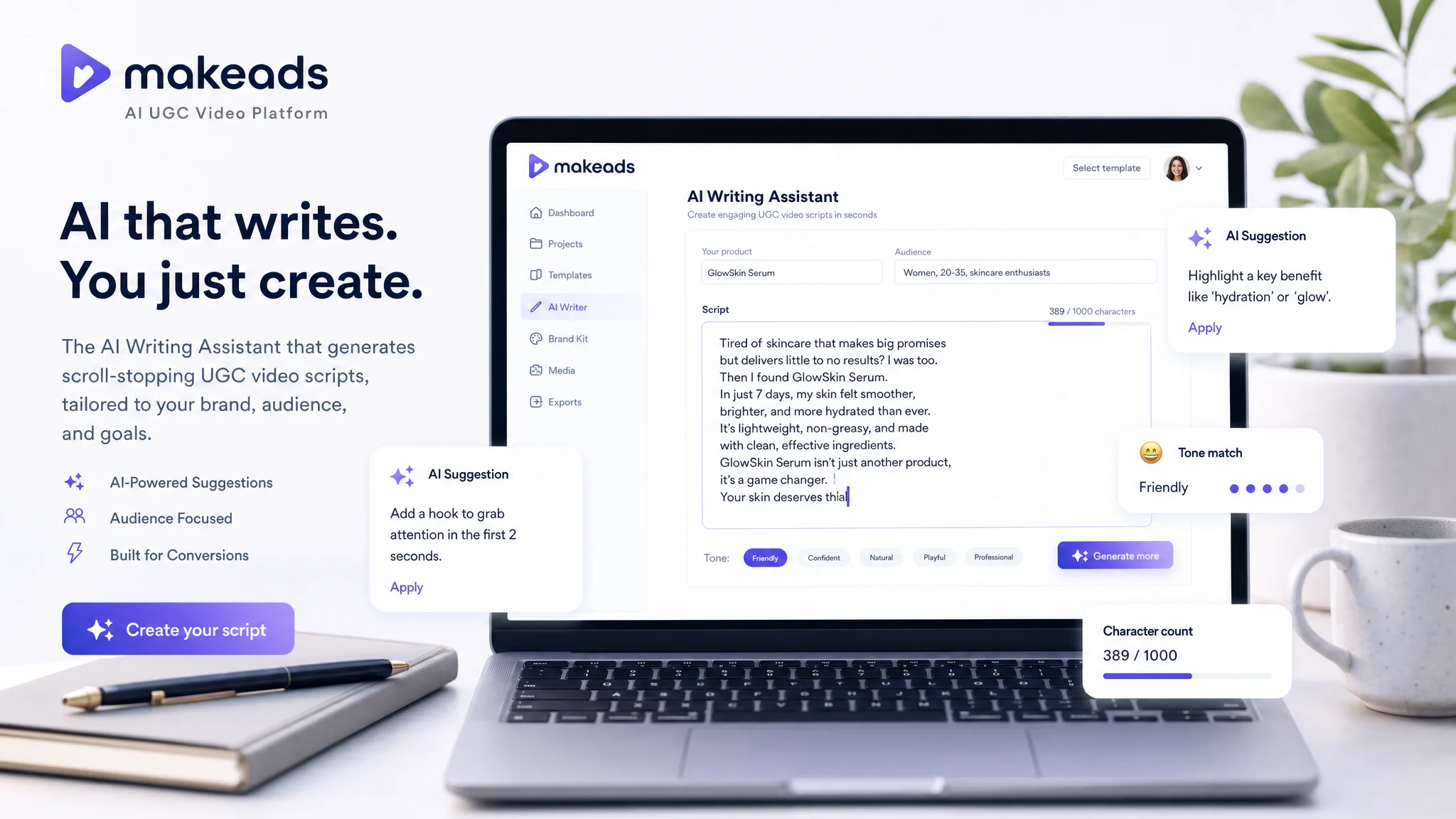
A script is only useful if it can be produced quickly. The old workflow handed a script to a creator, waited days for a shoot, and then discovered the wording did not land on camera. An integrated script-to-video pipeline removes that delay. When you write or generate a script inside a platform like makeads, the same script drives the AI actor, the voice generation, the lip sync, and the subtitles in a single step. Changing one line regenerates the spoken audio and the mouth movement together, so script iterations take minutes instead of days.
This tight loop between writing and producing is what makes AI script generators genuinely valuable rather than just a faster way to produce mediocre copy. The faster you can move from script idea to watchable video, the more hook and proof variants you can test, and the faster your creative learns what the audience responds to. Treat the script generator as the start of a production loop, not the end of a writing task, and the output quality will compound with every iteration.
How to apply this guide in makeads
Use this guide as a practical checkpoint for planning AI UGC videos, comparing creative angles, and deciding which parts of your workflow should be scripted, generated, reviewed, localized, and tested first.
The most useful next step is to translate the advice into one production brief: define the audience, the opening hook, the proof moment, the actor style, subtitle requirements, and the metric you will use to decide whether a video variant is worth scaling.
Related focus areas for this topic include AI Script, Video Ads, UGC, Copywriting, Creative Strategy. If you are building a campaign library, connect this guide with your pricing assumptions, platform policy checks, and localization plan before creating the final export.