
AI Customer Testimonial Video Generator: Scale Social Proof Without a Film Crew
How AI customer testimonial video generators let brands produce authentic social proof at scale. Learn the formats, compliance considerations, and best tools for testimonial video ads.
Customer testimonials are among the highest-converting assets in performance marketing, yet they are also the hardest to produce at scale. Coordinating real customers, scheduling shoots, shipping equipment, and editing footage turns every testimonial into a multi-week project. AI customer testimonial video generators have changed the economics, letting brands turn written reviews and approved scripts into watchable testimonial video without a film crew.
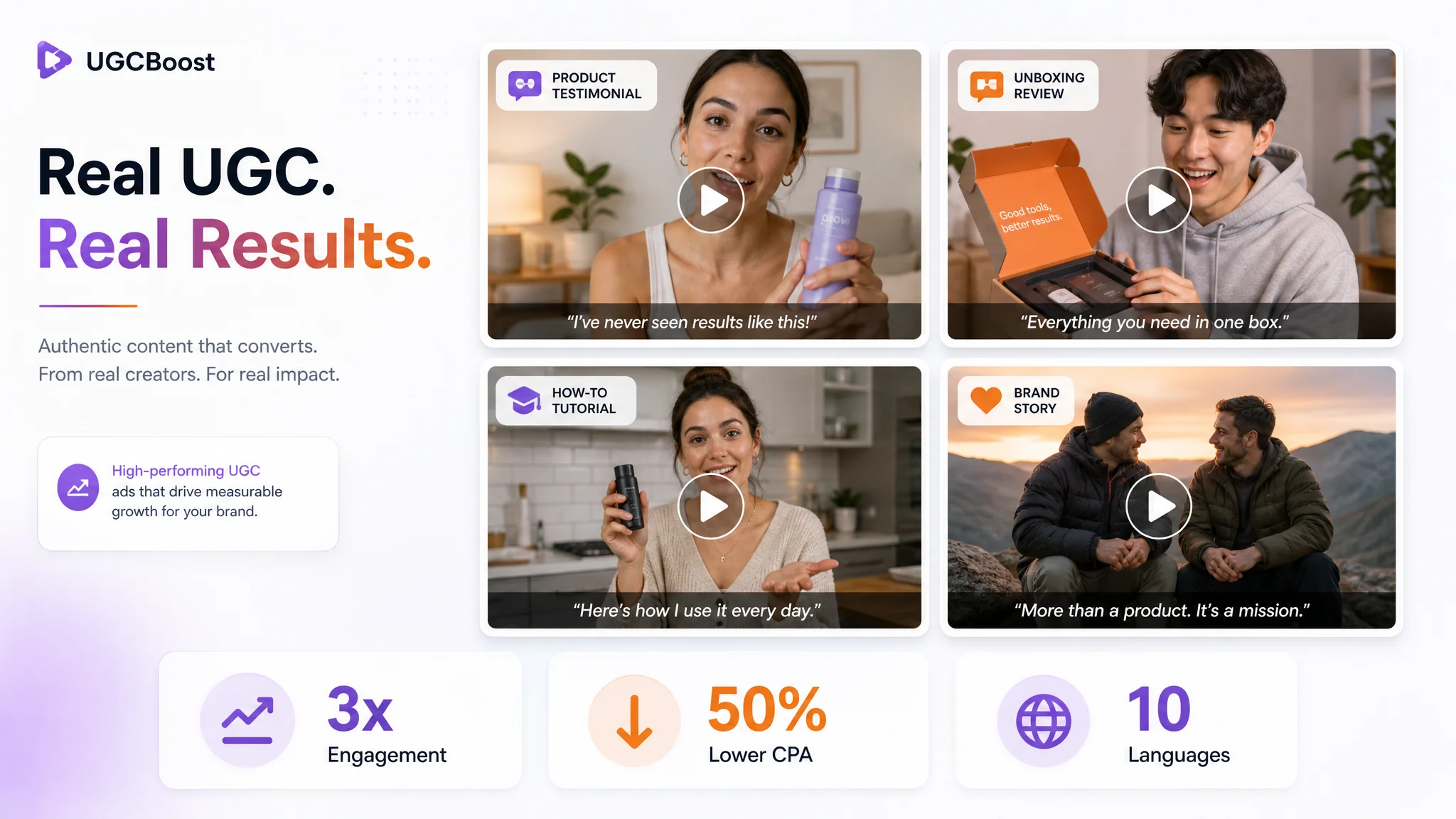
Why testimonial video converts
Testimonial video works because it transfers trust. A viewer who would dismiss a brand claim will accept the same claim from someone they perceive as a peer. The format carries built-in credibility: a real person, a real result, a real voice. This is why testimonial creative consistently outperforms product-spec creative in cold-audience ad campaigns where the viewer has no prior relationship with the brand.
The bottleneck has never been the strategy. It has been production. A brand with thousands of five-star reviews has, in effect, thousands of potential testimonial videos locked inside text. An AI testimonial generator unlocks that library by turning written reviews into spoken, performed video that can be deployed as ad creative.
How an AI testimonial generator works
The workflow starts with source material: a written customer review, a recorded interview transcript, or a scripted story based on real customer outcomes. The text is shaped into a first-person narrative with a clear hook, a specific result, and a relatable context. An AI actor is then cast to match the demographic and tone of the intended audience, the script is delivered with natural voice and lip sync, and the result is a testimonial-style video produced without scheduling a single customer.
The best results come from scripts that stay specific. A testimonial that says the product saved two hours every Friday afternoon converts better than one that says the product is amazing. AI generation makes it easy to test multiple specificity levels, multiple actors, and multiple result framings against the same underlying story, which is something traditional testimonial production could never afford to do.
Compliance and authenticity considerations
Producing testimonial-style video with AI actors raises a compliance question that brands must handle deliberately. The core principle is that the substance of the testimonial, the result, the problem solved, and the use case, must reflect real customer outcomes. AI is the delivery method, not the source of the claim. Brands should ground every AI testimonial in a real review, a real support ticket, or a real interview, and keep documentation linking the video to its source.
Disclosure rules vary by market and platform. Some regions require clear labeling when synthetic media is used in advertising. The safest approach is to treat AI testimonial video the same way you would treat any paid endorsement: ensure the claims are substantiated, the results are realistic, and the audience is not being misled about the nature of the product. A platform like makeads that produces the video is a production tool; the responsibility for truthful claims remains with the brand.
Building a testimonial creative library
The strategic advantage of AI testimonial generation is library building. Instead of betting a campaign on one or two expensive customer shoots, a brand can maintain a constantly refreshing library of testimonial variants organized by product line, audience segment, and result type. When an ad starts to fatigue, the next testimonial is already produced and ready to rotate in. Over a quarter, this library approach produces measurably lower costs per acquisition than sporadic testimonial production, because the marginal cost of each new variant is negligible once the workflow is established.
How to apply this guide in makeads
Use this guide as a practical checkpoint for planning AI UGC videos, comparing creative angles, and deciding which parts of your workflow should be scripted, generated, reviewed, localized, and tested first.
The most useful next step is to translate the advice into one production brief: define the audience, the opening hook, the proof moment, the actor style, subtitle requirements, and the metric you will use to decide whether a video variant is worth scaling.
Related focus areas for this topic include Testimonials, Social Proof, AI UGC, Video Ads, Ecommerce. If you are building a campaign library, connect this guide with your pricing assumptions, platform policy checks, and localization plan before creating the final export.