
AI Influencer Generator Guide 2026: How to Create Virtual Brand Ambassadors
A complete guide to AI influencer generators in 2026: how to create virtual brand ambassadors, what tools to use, costs, legal considerations, and how AI influencers compare to human creators.
AI influencers have moved from novelty to marketing strategy. Major brands now deploy virtual brand ambassadors that post content, engage followers, and drive sales without the scheduling, negotiation, and creative inconsistency that comes with human influencer partnerships. The tools for creating AI influencers have become accessible enough that even small marketing teams can build and manage virtual personalities.
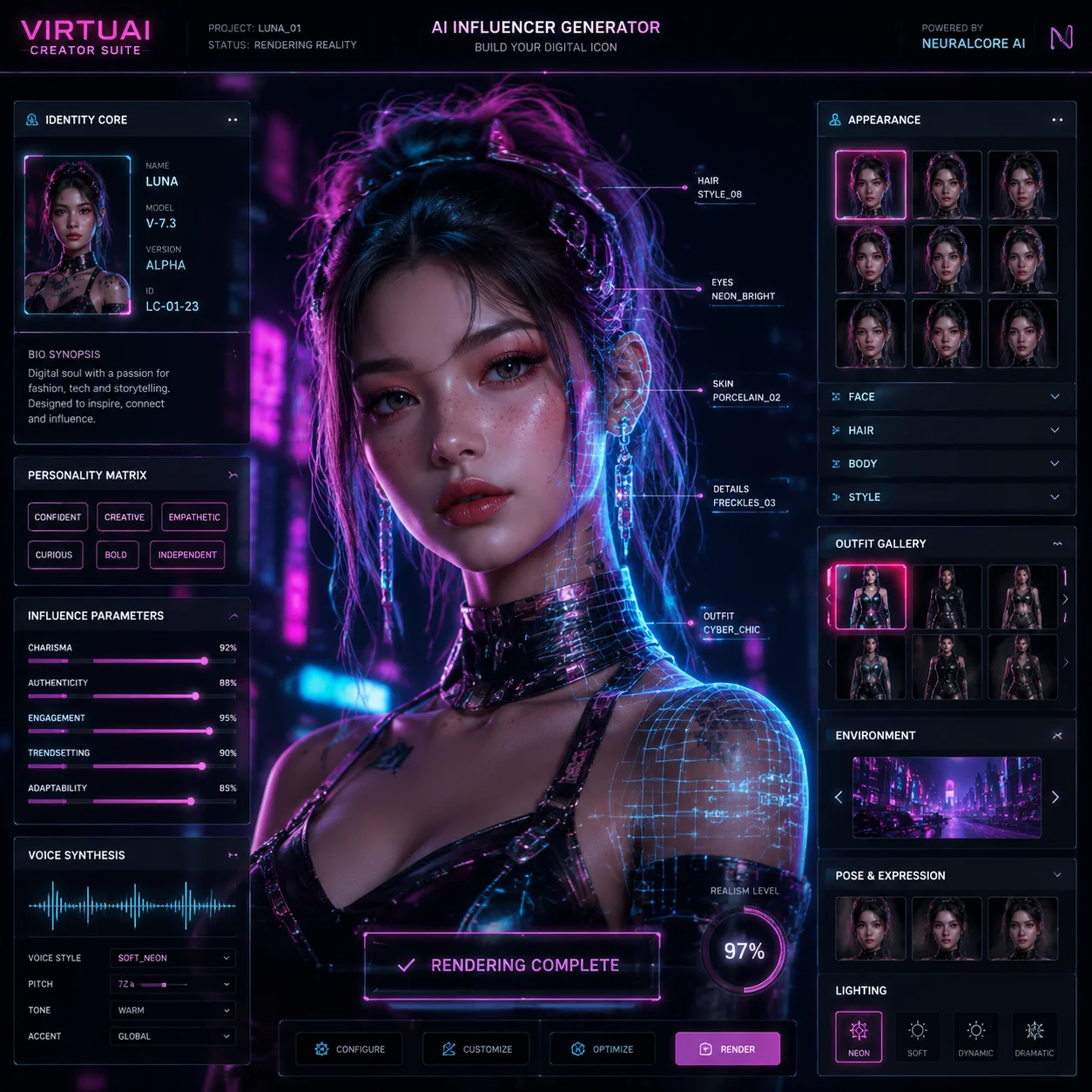
What is an AI influencer?
An AI influencer is a computer-generated character designed to appear as a real person on social media. These virtual personalities post photos, videos, and stories just like human influencers. They interact with followers, promote products, and build audience relationships. The key difference is that every aspect of their content can be controlled: their appearance, voice, personality, posting schedule, and brand messaging are all managed through creative and AI tools rather than through coordination with a real person.
The most successful AI influencers, like Lil Miquela and Aitana Lopez, have accumulated millions of followers and secured brand deals with major companies. Their appeal comes from a combination of consistent visual identity, carefully crafted personality, and content that fits seamlessly into social media feeds. Viewers engage with them the same way they engage with human influencers: by commenting, sharing, and following brand recommendations that feel like peer suggestions rather than advertisements.
How to create an AI influencer
Creating an AI influencer starts with character design. Define your virtual ambassador's visual appearance, personality traits, content niche, and target audience before generating any content. The character should fill a specific gap in the market: a fitness AI influencer for athleisure brands, a tech reviewer for gadget companies, or a lifestyle creator for home and fashion brands. The more specific the positioning, the easier it is to create content that resonates with a defined audience.
Once the character concept is locked, AI image and video generation tools handle visual content creation. You need a consistent face model that generates reliable likeness across different poses, outfits, and settings. For video content, AI talking actor platforms can animate the virtual influencer delivering scripted lines with natural facial expressions and lip sync. The output pipeline combines character design, script writing, visual generation, and scheduling into a repeatable content calendar.
Free and paid AI influencer tools
Several platforms now specialize in AI influencer creation, ranging from free basic tools to enterprise platforms. Free tools typically offer limited character customization and lower resolution output, making them suitable for experimentation and proof of concept. Paid platforms provide consistent character rendering across multiple content formats, higher resolution output suitable for professional campaigns, and workflow features like content scheduling and multi-platform publishing.
For video-focused AI influencers, platforms that combine character generation with AI talking actors and lip sync provide the most efficient production workflow. Rather than generating static images and animating them in separate tools, an integrated platform keeps the character consistent across photos and videos while supporting natural speech, expressions, and movement that make the virtual influencer feel authentic on video platforms like TikTok and Instagram Reels.
Legal and ethical considerations
AI influencers raise important legal and ethical questions that every brand should address before launching a virtual ambassador. Disclosure is the most critical: most platforms including Instagram and TikTok require clear labeling of AI-generated or synthetic content. Failing to disclose that an influencer is AI-generated can violate platform policies and consumer protection regulations in multiple jurisdictions.
Representation and authenticity are also worth careful consideration. AI influencers should not impersonate real individuals or use likenesses without consent. The character design should avoid reinforcing harmful stereotypes or presenting unrealistic standards in ways that could mislead audiences. Brands that approach AI influencers transparently and thoughtfully tend to build more trust with their audiences than those that try to pass virtual characters off as real people.
AI influencers vs human creators
AI influencers are not a replacement for every human creator partnership. They excel in scenarios requiring consistent brand messaging, high content volume, multi-language localization, and zero scheduling friction. Human creators excel at authentic lived experience, unscripted moments, and the genuine personality that viewers can sense and trust. The most effective influencer strategies in 2026 combine both: AI influencers for consistent brand presence and scalable content volume, and human creators for campaigns where authentic personal endorsement drives the highest conversion value.
How to apply this guide in makeads
Use this guide as a practical checkpoint for planning AI UGC videos, comparing creative angles, and deciding which parts of your workflow should be scripted, generated, reviewed, localized, and tested first.
The most useful next step is to translate the advice into one production brief: define the audience, the opening hook, the proof moment, the actor style, subtitle requirements, and the metric you will use to decide whether a video variant is worth scaling.
Related focus areas for this topic include AI Influencer, Virtual Influencer, Content Marketing, AI Video. If you are building a campaign library, connect this guide with your pricing assumptions, platform policy checks, and localization plan before creating the final export.