
TikTok Ads Pricing in 2026: What It Actually Costs to Advertise on TikTok
A complete breakdown of TikTok ads pricing in 2026: minimum budgets, CPM and CPC benchmarks, ad format costs, and how to calculate your expected spend before launching your first campaign.
TikTok advertising costs are structured differently from most major ad platforms, and misunderstanding the minimum budgets, auction mechanics, and format-specific pricing can lead to campaigns that stall before generating any useful data. This guide explains every TikTok ad cost component in 2026 so you can plan budgets accurately and choose the right formats for your campaign objectives.
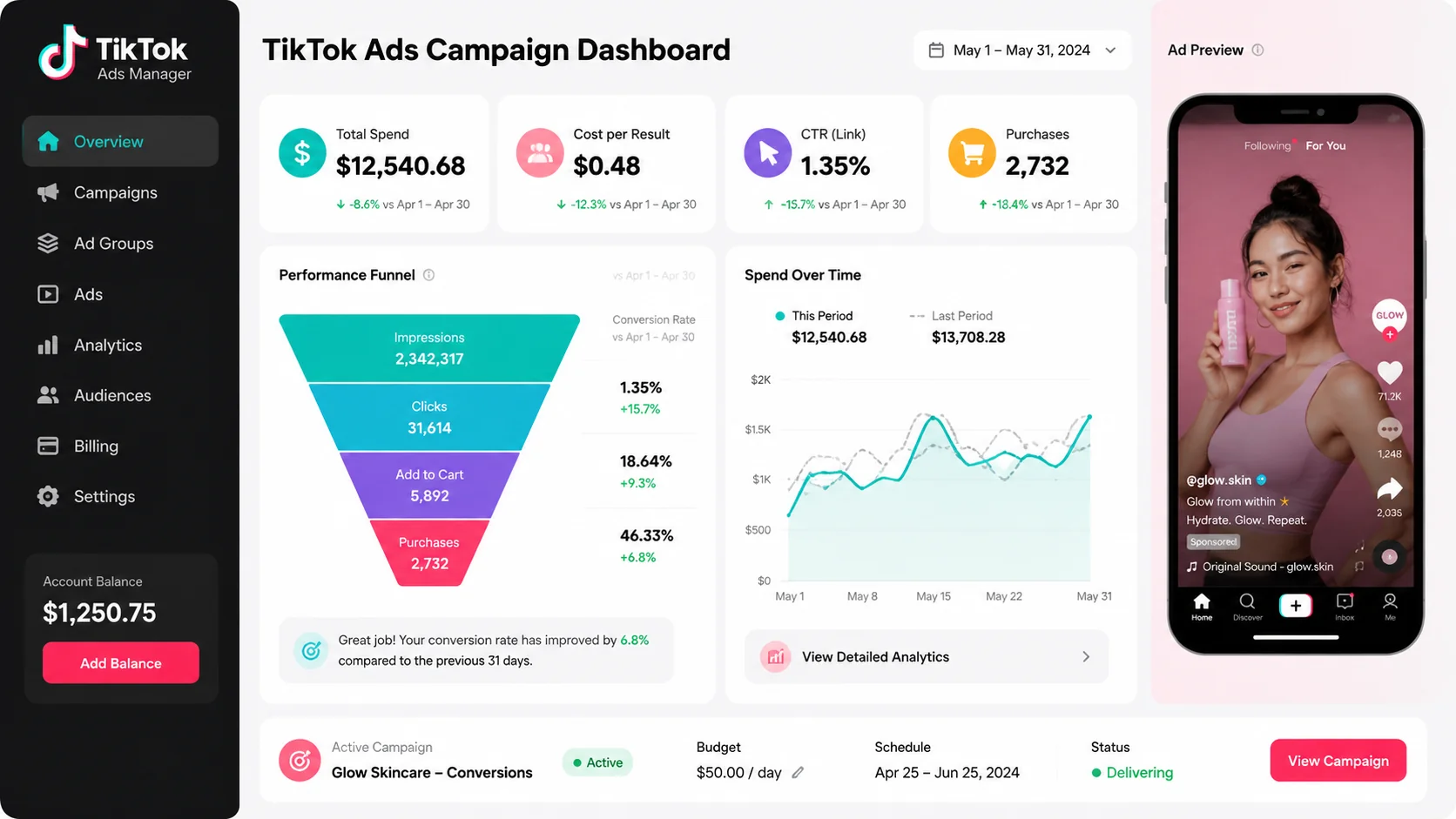
TikTok ad platform minimum budgets
TikTok Ads Manager enforces minimum daily budgets at both the campaign and ad group level. At the campaign level, the minimum is fifty dollars per day. At the ad group level, the minimum is twenty dollars per day. This means the true floor for running a single ad group within a campaign is around fifty to seventy dollars per day combined. For comparison, Meta's minimum daily budgets are significantly lower, which is why small advertisers sometimes find TikTok harder to test at very limited spend levels.
The budget minimums exist because TikTok's algorithm requires a meaningful spend window to exit the learning phase. Running below minimum thresholds produces erratic delivery and unreliable performance data. Budget accordingly from the start: plan to run each creative test for at least five to seven days at or above the ad group minimum to collect data that is actionable rather than statistically noisy.
CPM and CPC benchmarks in 2026
TikTok CPM (cost per thousand impressions) varies significantly by industry, audience, and competitive landscape. Across most consumer categories in North American and Western European markets, typical CPM ranges from nine to twenty-five dollars. E-commerce and direct-to-consumer brands often see CPMs in the ten to eighteen dollar range on broad targeting. Financial services and B2B software categories tend to have higher CPMs, often twenty to forty dollars, because advertiser competition for professional-skewing audiences is more intense.
CPC (cost per click) typically runs from fifty cents to two dollars for most consumer products, with high-converting creatives on the lower end and weak creatives or competitive categories pushing toward the upper end. Because TikTok's auction system weights engagement rate heavily, a strong creative with high watch time and click-through rate will consistently win auctions at lower CPCs than a mediocre creative bidding at the same level. This means creative quality has a direct and measurable impact on your effective cost per result.
Ad format cost differences
TikTok offers several ad formats, and the cost structure differs meaningfully between them. In-feed video ads, which appear in the For You feed and are the most commonly used format, operate on the standard auction-based CPM or CPC model. TopView ads, which appear as the first video when a user opens the app, are sold on a reservation basis with premium pricing typically starting at several thousand dollars per day for national campaigns. Branded Hashtag Challenges carry a flat fee in the range of one hundred fifty thousand dollars or more for the dedicated challenge page, making them relevant only to large brand budgets.
For most performance marketers, in-feed video ads using the Traffic, Conversions, or App Install objectives are the primary format. Spark Ads, which allow boosting organic content as paid ads, often deliver better CPMs than standard in-feed placements because the content already has organic engagement signals that TikTok's algorithm evaluates favorably.
How creative quality affects your effective cost
TikTok's ad auction system is more creative-quality sensitive than most other platforms. The algorithm evaluates every ad's organic engagement signals — watch time completion rate, shares, comments, and saves — and factors these into the delivery auction in real time. A creative that holds attention consistently through the first three seconds receives a higher quality score, which translates to winning more auction impressions at the same bid level compared to a creative with poor retention.
This dynamic means that investing in better creative production directly reduces your effective CPM and CPA. AI-generated UGC-style video ads tend to perform well on TikTok precisely because they match the native feel of organic content that users are already engaging with in their feeds. A polished, highly produced ad often underperforms a naturalistic talking-head video with a strong hook, even when the polished version has higher production cost behind it.
Budget allocation strategy for testing
A practical starting budget for a TikTok ad test is three hundred to five hundred dollars over one week, which allows running two to three ad creatives at sufficient daily spend to exit the learning phase within three to four days. Allocate the majority of budget to the ad objective most relevant to your funnel stage: Traffic for top-of-funnel awareness, Conversions or Product Sales for direct response, and App Install for mobile acquisition campaigns.
After the initial test period, cut the bottom-performing creatives and reallocate budget to the winners. Scale incrementally rather than multiplying budget by large factors at once, as sudden large budget increases can disrupt delivery patterns and cause CPMs to spike while the algorithm recalibrates. A twenty to thirty percent weekly budget increase on proven performers typically maintains stable delivery and predictable cost-per-result as you scale.
TikTok ads versus other platforms on cost efficiency
Compared to Meta, TikTok advertising in 2026 generally offers lower CPMs in most consumer categories, but requires stronger native-format creative to realize that cost advantage. Brands that repurpose polished Instagram video ads onto TikTok without reformatting for the platform's native style typically see higher CPCs and lower return on ad spend than brands that invest in TikTok-native creative production. The platform rewards adaptation rather than asset repurposing.
For brands producing AI-generated video ads, the economics are favorable. Creating TikTok-optimized video variants with different hooks, different actors, and localized versions costs a fraction of traditional production, making it practical to run multiple simultaneous creative tests at the budget thresholds where TikTok's algorithm produces reliable data.
How to apply this guide in makeads
Use this guide as a practical checkpoint for planning AI UGC videos, comparing creative angles, and deciding which parts of your workflow should be scripted, generated, reviewed, localized, and tested first.
The most useful next step is to translate the advice into one production brief: define the audience, the opening hook, the proof moment, the actor style, subtitle requirements, and the metric you will use to decide whether a video variant is worth scaling.
Related focus areas for this topic include TikTok Ads, Ad Pricing, Social Media Advertising, Performance Marketing. If you are building a campaign library, connect this guide with your pricing assumptions, platform policy checks, and localization plan before creating the final export.