
Lip Sync AI API Comparison 2026: Best Tools for Video Dubbing and Localization
A technical comparison of lip sync AI APIs in 2026 for automated video dubbing, multi-language localization, and talking avatar generation, including pricing, accuracy, and integration guidance.
Lip sync technology powered by AI has become one of the most impactful capabilities in video production. Instead of manually adjusting mouth movements frame by frame or reshooting content for every language, lip sync AI APIs automatically match mouth movements to any audio track. For development teams building video products, choosing the right lip sync API affects output quality, processing cost, and the end-user experience. This guide compares the leading options in 2026.
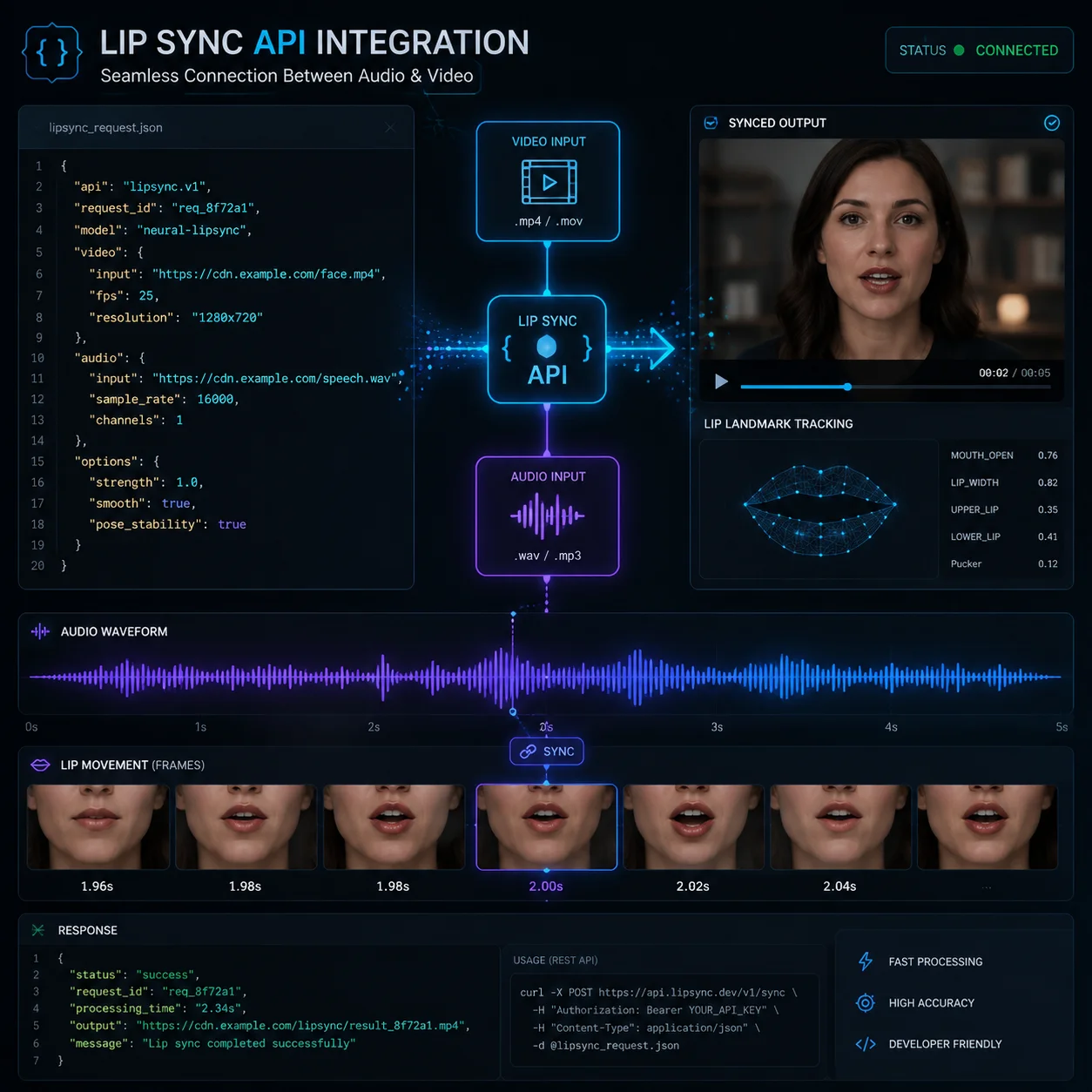
How lip sync AI APIs work
Lip sync APIs take two inputs: a video containing a speaking person and an audio track with speech. The API analyzes the audio phonemes, maps them to corresponding mouth shapes, and modifies the video frames to match the new audio. The best systems handle this transformation while preserving natural facial expressions, head movement, and overall visual quality. Processing typically happens in the cloud, with the API returning either a processed video file or a streamable URL.
The technical challenge is maintaining temporal consistency across frames. When audio is changed, every frame where the mouth is visible needs updating, but the surrounding face must remain stable. Flickering, unnatural jaw movements, or mismatched facial muscle activation are common artifacts in lower-quality lip sync systems. Top-tier APIs use sophisticated face tracking models that understand the full facial animation system rather than simply swapping mouth shapes.
Key features to evaluate
When comparing lip sync APIs, test across these dimensions. Multi-language support is essential for localization use cases: the API should handle phonemes from languages beyond English, including tonal languages where mouth shapes differ significantly from Western speech patterns. Resolution support determines output quality: some APIs cap at 720p while others support 1080p or 4K, which matters for commercial video production. Processing speed affects operational workflow: real-time or near-real-time processing enables interactive use cases, while batch processing with longer turnaround may be acceptable for scheduled localization jobs.
Audio-video sync accuracy is the most important benchmark. Test with different speaker types, accents, and speaking speeds. Record the baseline lip sync accuracy for neutral speech, fast speech, emotional speech, and speech with background music or ambient noise. The best APIs maintain high accuracy across all conditions, while budget options may degrade noticeably with faster speech or non-English audio.
Leading lip sync API providers
Several platforms dominate the lip sync API market in 2026. Major AI video platforms like Kling AI offer lip sync as part of their broader video generation toolkit, which is convenient for teams already using those platforms for content creation. Standalone lip sync API providers offer deeper customization, more language support, and often better per-unit pricing for high-volume use cases. Some open-source models exist for teams with the infrastructure to self-host, though these require significant GPU resources and engineering investment to match the quality and reliability of commercial APIs.
For teams building dubbing and localization pipelines, the integration complexity matters as much as raw sync quality. Look for APIs with clean REST interfaces, webhook support for async processing, detailed status reporting, and robust error handling. Production pipelines need reliability: a lip sync API that occasionally returns corrupted frames or silently drops audio segments creates expensive downstream quality assurance work.
Pricing models for lip sync APIs
Lip sync API pricing typically follows one of three models: per-minute, per-request, or subscription with usage caps. Per-minute pricing charges based on the duration of processed video, which is predictable and easy to budget. Per-request pricing charges a flat fee per API call regardless of video length, which can be economical for short clips but expensive for longer content. Subscription models bundle a monthly processing allowance with overage charges, suitable for workloads with predictable monthly volumes.
For production-scale localization, volume pricing and committed-use discounts can significantly reduce the effective per-minute cost. Most providers offer custom pricing for enterprise volumes above a certain threshold, and the savings can be substantial. Teams processing thousands of minutes per month should negotiate directly rather than accepting published rates. The per-minute cost at scale often drops by forty to sixty percent compared to pay-as-you-go pricing.
How to apply this guide in makeads
Use this guide as a practical checkpoint for planning AI UGC videos, comparing creative angles, and deciding which parts of your workflow should be scripted, generated, reviewed, localized, and tested first.
The most useful next step is to translate the advice into one production brief: define the audience, the opening hook, the proof moment, the actor style, subtitle requirements, and the metric you will use to decide whether a video variant is worth scaling.
Related focus areas for this topic include Lip Sync, AI API, Video Dubbing, Developer Tools. If you are building a campaign library, connect this guide with your pricing assumptions, platform policy checks, and localization plan before creating the final export.