
AI Marketing Campaign Generator: How to Use AI to Build and Launch Ad Campaigns Faster
A practical guide to AI marketing campaign generators in 2026: which tools automate brief creation, creative generation, audience targeting, and campaign structure, and how to combine them into a working end-to-end workflow.
AI marketing campaign generators have evolved well beyond simple copywriting assistants. In 2026, the best tools can take a product brief and output a full campaign structure: audience segments, ad angles, creative scripts, visual prompts, and platform-specific format recommendations. This guide covers what these tools actually do, where they fall short, and how to build a practical workflow that combines AI-generated campaign components with the strategic judgment that only humans can provide.
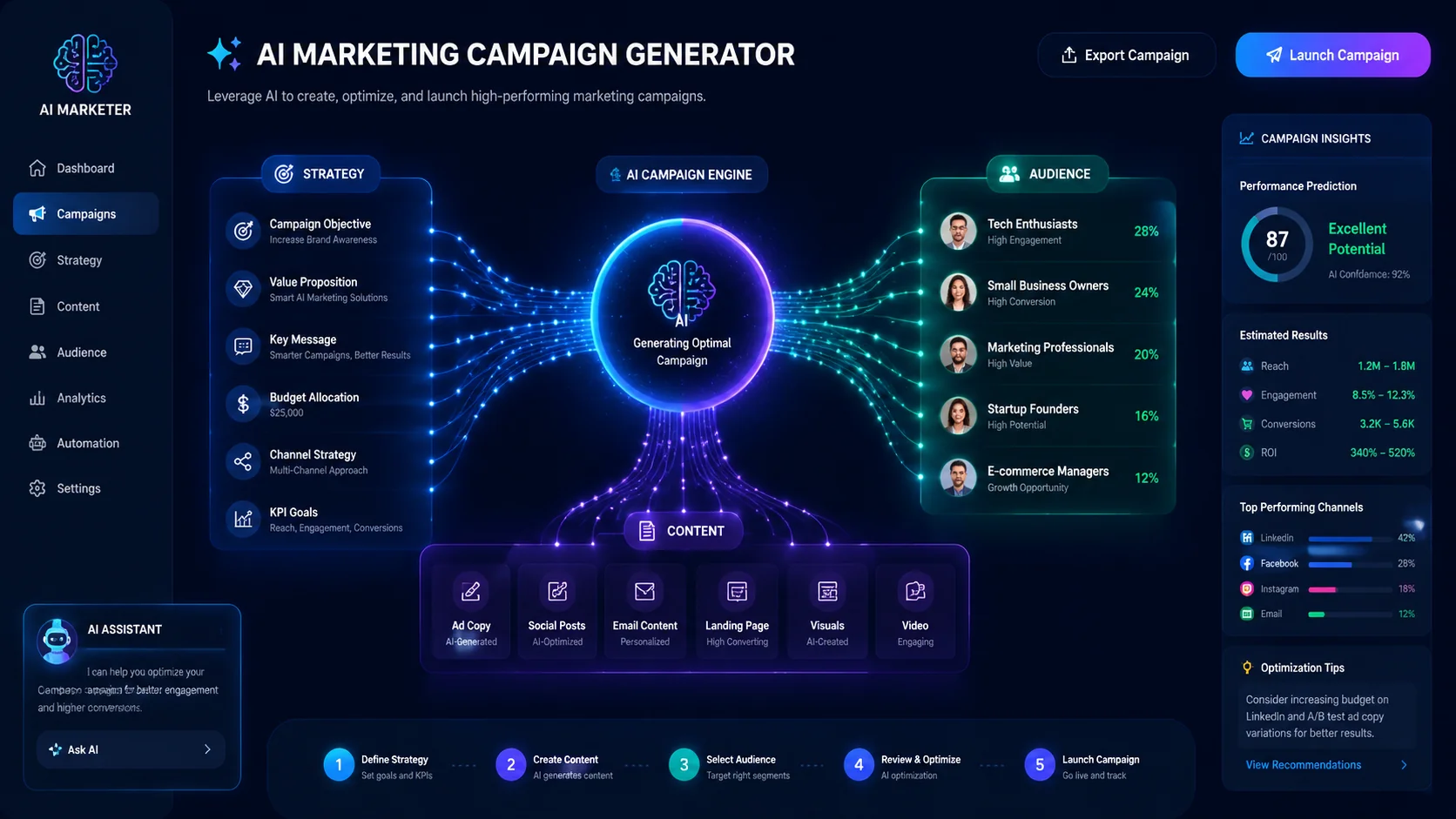
What AI campaign generators can and cannot do
A good AI marketing campaign generator takes a product description, target audience, and campaign objective as input and produces a structured campaign blueprint as output. This typically includes suggested audience segments with pain-point descriptions, campaign messaging angles ranked by expected relevance, ad script outlines for different formats, a hook matrix for short-form video content, and platform placement recommendations based on the product category and audience profile.
What these tools cannot do is replace market knowledge, brand judgment, or creative instinct. An AI generator working from a generic product brief will produce generic campaign structures. The output quality scales directly with the specificity and quality of the input. Teams that invest time in writing precise input briefs — with specific audience segments, named competitors, documented customer language from reviews, and concrete proof assets — get campaign structures they can use immediately. Teams that feed vague product descriptions get vague campaign suggestions that require extensive human refinement.
The most useful AI tools for campaign generation in 2026
Campaign generation tools fall into three categories. General-purpose AI writing assistants can generate campaign structures when prompted with specific frameworks, but require the user to know which frameworks to ask for. Marketing-specific AI platforms offer guided campaign generation interfaces that walk through audience, message, format, and creative dimensions with structured prompts. Integrated ad platform AI features offered by Meta, Google, and TikTok directly within their ad managers generate campaign suggestions based on your historical account performance data, which makes their recommendations more contextually relevant than standalone tools.
For most performance marketing teams, the practical stack is a marketing-specific AI tool for initial campaign ideation and structure, combined with a video AI platform for creative generation. The campaign AI handles strategy layer: audience definition, message angles, competitive positioning. The video AI handles execution layer: turning approved scripts into generated video ad variants at scale.
Building a campaign brief that AI tools can actually use
The quality of AI campaign output depends entirely on input quality. A brief that will generate useful campaign output needs five specific elements. First, audience specificity: describe the target customer in behavioral and situational terms, not demographic labels. Instead of women aged 25-35, write frequent online shoppers who research purchases extensively before buying and read multiple reviews before committing. Second, the specific pain point the product resolves, stated in language customers actually use in reviews and social comments. Third, the single outcome claim the campaign is built around. Fourth, the primary proof asset that makes the claim credible. Fifth, competitive context: which alternative are customers currently using, and why is your product a better choice for this specific audience.
Feed this structured brief into an AI campaign generator and the output will be a set of specific, usable campaign angles. Each angle can then be developed into scripts, creative briefs for video production, and audience targeting recommendations for individual ad sets.
Automating creative production from the campaign blueprint
Once the AI generator produces a campaign blueprint, the next step is translating each angle into produced creative assets. For video ad campaigns, this means taking each script outline from the generator and developing it into a production-ready brief for the video AI platform. The video platform then generates talking-head presenter videos, product demonstration clips, or lifestyle visuals based on the script brief.
The automation advantage at this stage is the ability to run multiple angles in parallel rather than sequentially. Instead of waiting for one angle to be produced, reviewed, and launched before starting the next, AI video production allows three or four angles to go through the pipeline simultaneously. The first week of data reveals which angles drive the best cost-per-result, and subsequent production resources concentrate on the strongest performers.
Campaign generator output that needs human review
Several categories of AI campaign output should always receive human review before going to production. Claims that could be interpreted as performance guarantees need verification against available proof. Audience descriptions that touch on health, financial outcomes, or personal transformation need compliance review for the specific platforms and markets being targeted. Competitive positioning language should be reviewed for accuracy and legal risk, particularly any language that makes direct comparisons to named competitors.
The goal is not to verify everything exhaustively, which would eliminate the speed advantage of AI generation. The goal is a focused review layer that catches the specific claim types and language patterns that create legal, policy, or brand risk. Building a simple checklist of review triggers — claim types that always need human eyes — makes this review fast and consistent rather than variable and dependent on whoever happens to review that week.
Measuring campaign generator ROI
The clearest measure of an AI campaign generator's value is the reduction in time from initial brief to first live ad. For most teams, manual campaign planning takes several days of strategy discussion, messaging workshops, and creative brief development. An AI generator running from a precise product brief can compress this to a few hours of structured generation and focused human review. Multiply this time saving across the number of campaigns your team launches per quarter, and the productivity impact of AI campaign generation becomes one of the most measurable efficiency gains in the modern marketing stack.
How to apply this guide in makeads
Use this guide as a practical checkpoint for planning AI UGC videos, comparing creative angles, and deciding which parts of your workflow should be scripted, generated, reviewed, localized, and tested first.
The most useful next step is to translate the advice into one production brief: define the audience, the opening hook, the proof moment, the actor style, subtitle requirements, and the metric you will use to decide whether a video variant is worth scaling.
Related focus areas for this topic include AI Marketing, Campaign Generator, Marketing Automation, Ad Creative. If you are building a campaign library, connect this guide with your pricing assumptions, platform policy checks, and localization plan before creating the final export.