
AI Generated Commercial Guide: From Campaign Brief to Finished Video Ad
Learn how to plan an AI generated commercial with a clear brief, storyboard, product proof, actor direction, review gates, and reusable ad variants.
An AI generated commercial can be produced much faster than a traditional shoot, but speed does not remove the need for creative structure. The best results still come from a clear brief, a tight story, a visual proof plan, and review checkpoints that prevent the final video from looking polished but unfocused.
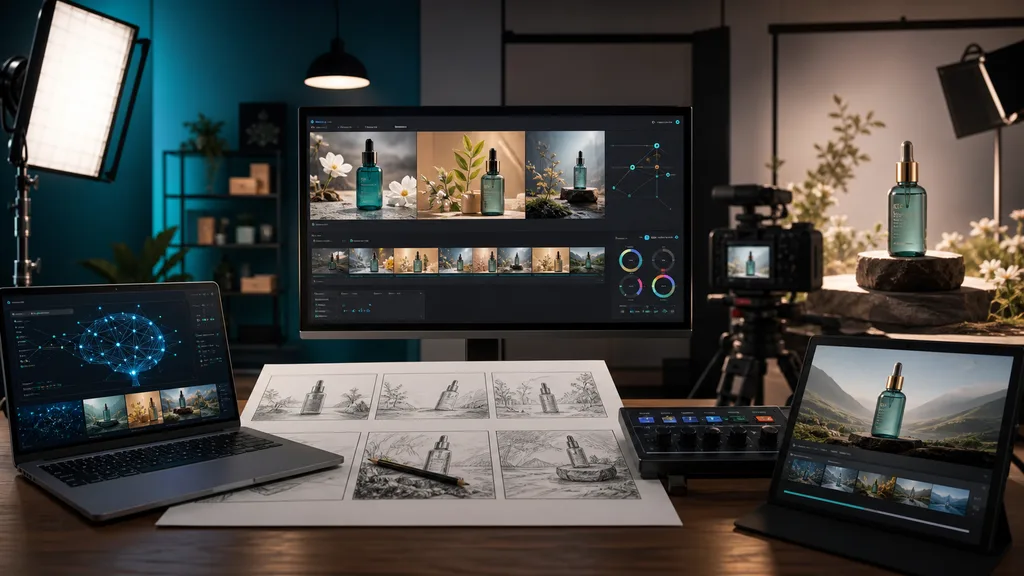
Decide what the commercial must prove
Traditional commercials often begin with a concept. AI commercials should begin with a proof requirement. What must the viewer believe after watching? That the product saves setup time? That the service is easier than a competitor? That a buyer can get a result without a large team? The answer shapes the entire video.
Write one sentence before generating anything: after watching this commercial, the viewer should believe that our product helps them do X because they saw Y. X is the promise. Y is the proof. This prevents the AI generated commercial from becoming a montage of attractive but disconnected visuals.
Storyboard the message in six beats
A strong short commercial can be planned in six beats: hook, problem, product, proof, outcome, and CTA. The hook earns attention. The problem shows relevance. The product introduces the solution. The proof makes the claim believable. The outcome translates the feature into buyer value. The CTA tells the viewer what to do next.
Keep each beat short. If a beat needs a paragraph of explanation, the commercial will probably feel slow. AI can produce visuals quickly, but it cannot save a story that lacks priority. The storyboard should make clear which scene carries which job.
Choose the right format
Not every AI generated commercial needs to look cinematic. For paid social, a UGC-style presenter plus product proof may outperform a glossy brand film. For launch pages, a cleaner product explainer may work better. For retargeting, a testimonial-style commercial can answer objections. Pick the format based on funnel stage and buyer skepticism, not based on what looks most expensive.
Use AI actors with clear direction
If the commercial includes an AI actor, give the actor a role: expert advisor, founder, customer, reviewer, or category guide. Then adjust the script for that role. A founder can speak about why the product exists. A reviewer should compare practical differences. A customer should describe a before-and-after situation. This makes the delivery feel intentional instead of generic.
Review claims before scaling variants
AI makes it easy to generate many commercials from one idea, but claim review should happen before scale. Check prices, guarantees, health or financial claims, testimonials, before-and-after statements, and rights for product images or footage. Keep a simple evidence file with approved proof sources and language. That file speeds up the next batch.
Turn one commercial into a testing system
After the first version is approved, create variants with controlled changes. Try a problem-led hook, a demo-led hook, and an objection-led hook. Try a founder delivery versus customer delivery. Try a short version for cold traffic and a slightly longer proof version for retargeting. Label each export so results can be read later.
Know when to keep real footage
AI commercial generation does not require replacing every asset. If the team already has strong product footage, customer clips, or approved brand visuals, use them as proof and let AI handle presenter delivery, structure, and variant production. Hybrid workflows are often stronger than fully generated ones because real product evidence anchors the message while AI removes the slow parts of scripting, localization, and versioning.
The advantage of an AI generated commercial is not only lower production cost. It is the ability to make video advertising more systematic. When each commercial has a clear proof target, a structured storyboard, and clean variant naming, creative testing becomes faster and easier to learn from.
How to apply this guide in makeads
Use this guide as a practical checkpoint for planning AI UGC videos, comparing creative angles, and deciding which parts of your workflow should be scripted, generated, reviewed, localized, and tested first.
The most useful next step is to translate the advice into one production brief: define the audience, the opening hook, the proof moment, the actor style, subtitle requirements, and the metric you will use to decide whether a video variant is worth scaling.
Related focus areas for this topic include AI Generated Commercial, Commercial Generator, Video Production, Ad Creative. If you are building a campaign library, connect this guide with your pricing assumptions, platform policy checks, and localization plan before creating the final export.