
Product Advertising with AI: A Proof-First Workflow for Video Ads
A practical guide to product advertising with AI video tools, covering proof moments, scripts, actor fit, offer clarity, testing, and reusable ad variants.
Product advertising works when the viewer can quickly understand what the product is, why it matters, and what proof supports the claim. AI video tools can speed up production, but they do not change that rule. The strongest product ads are proof-first: they show the product solving a real problem before the script asks for trust.
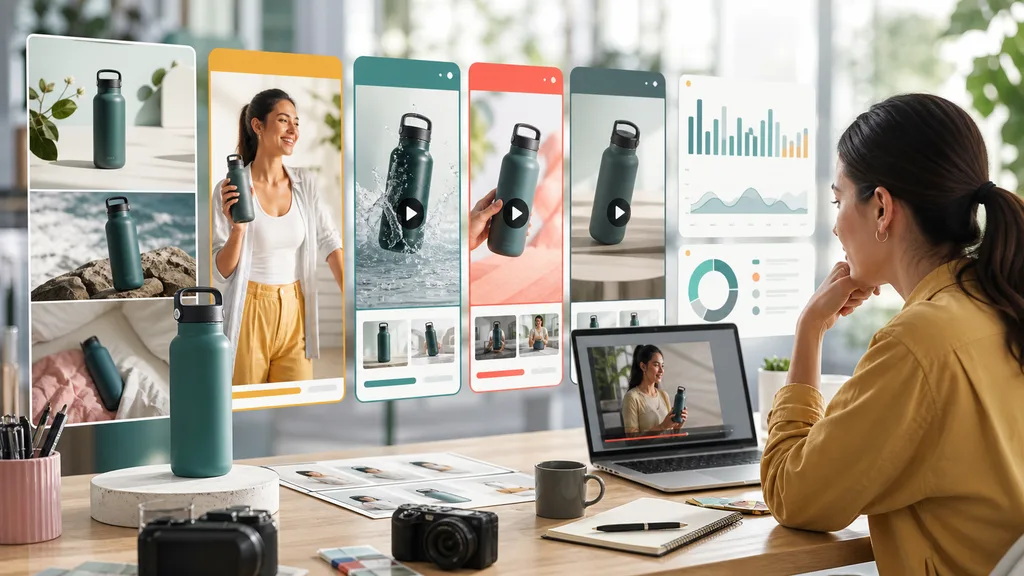
Pick one proof moment
A proof moment is the part of the ad that makes the promise believable. It might be a side-by-side comparison, a short demo, a texture close-up, a customer review, a screen recording, or a before-and-after result. Choose one proof moment before writing the script. If the ad tries to prove everything, it usually proves nothing.
For simple products, the proof may be visual. Show how it opens, fits, cleans, organizes, tracks, protects, or improves a specific task. For software, the proof may be a workflow step or result screen. For services, the proof may be the speed of setup, clarity of process, or quality of outcome.
Write the script around the proof
Start with the buyer's problem, then move quickly to the proof. A useful structure is: problem, product, proof, result, CTA. Keep the hook spoken and direct. Avoid opening with the brand name unless the brand already carries strong demand. Most viewers care first about their own problem, not the company.
AI product advertising workflows benefit from short sentences. Short lines are easier for AI actors to deliver, easier for subtitles to display, and easier for viewers to understand without sound. If the product requires explanation, split the script into two videos: a short prospecting ad and a longer retargeting ad.
Match actor to product category
A product ad with an AI presenter should feel category-native. A friendly reviewer can work for lifestyle and beauty. A practical operator can work for business tools. A confident guide can work for fitness or education. The actor does not need to be dramatic. They need to make the claim feel credible.
Create variant sets, not one-off ads
AI makes it affordable to build several versions, but each version should have a reason to exist. Create variant sets around hook angle, proof order, audience segment, offer, and CTA. Keep the product proof consistent when you test hooks. Keep the hook consistent when you test proof. This discipline turns product advertising from guessing into learning.
Use a mobile review checklist
Before launch, watch the ad on a phone. Can the product be recognized in the first seconds? Is the proof visible behind subtitles? Does the CTA match the landing page? Are any price or performance claims still current? Does the ad still make sense with sound off? These checks catch the common problems that look fine on a large editing monitor but fail in a social feed.
Connect creative data to the next batch
Product advertising improves when creative results are tagged. Label each export with product, audience, hook, proof, actor, offer, and platform. After launch, compare hold rate, click-through rate, conversion rate, and comments by those tags. A winning hook can be reused. A weak proof moment can be replaced. A strong actor can become the default for that product line.
Align the landing page
The product ad should not make a promise the landing page hides. If the video leads with a demo, the page should show that demo or proof near the top. If the video leads with a bundle, the page should make the bundle easy to find. This alignment protects conversion rate and helps the team understand whether a weak result came from the creative, the offer, or the post-click experience.
AI does not remove the fundamentals of product ads. It gives teams a faster way to apply them. When the workflow starts with proof, uses scripts built for speech, casts presenters intentionally, and measures variants cleanly, product advertising becomes easier to scale without becoming generic.
How to apply this guide in makeads
Use this guide as a practical checkpoint for planning AI UGC videos, comparing creative angles, and deciding which parts of your workflow should be scripted, generated, reviewed, localized, and tested first.
The most useful next step is to translate the advice into one production brief: define the audience, the opening hook, the proof moment, the actor style, subtitle requirements, and the metric you will use to decide whether a video variant is worth scaling.
Related focus areas for this topic include Product Advertising, Product Ads, AI Video Ads, Ecommerce. If you are building a campaign library, connect this guide with your pricing assumptions, platform policy checks, and localization plan before creating the final export.