
Google I/O 2026: AI Agents, Gemini Upgrades, and What It Means for Video Marketing
Key takeaways from Google I/O 2026 including Gemini upgrades, AI agent capabilities, and what these announcements mean for marketers creating video content and running advertising campaigns.
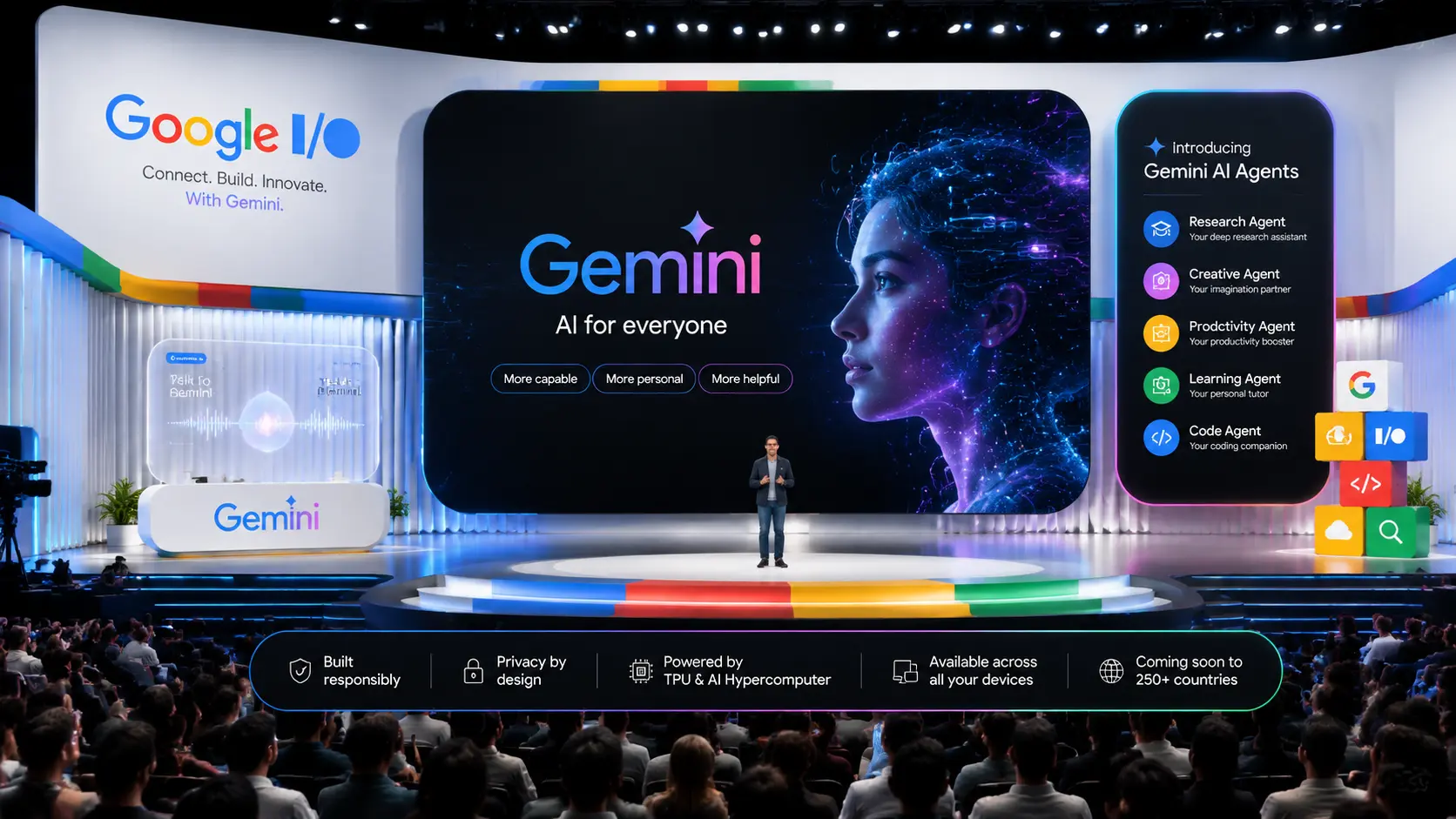
Google I/O 2026 positioned AI agents as the defining technology of the year, with Gemini upgrades taking center stage. For marketing teams, these announcements signal new capabilities for content creation, campaign automation, and customer engagement. Here is what matters for video marketing.
Gemini upgrades for content creation
The new Gemini version brings significant improvements to video understanding and generation capabilities. The model can now analyze longer video content, extract key moments, and generate summaries with timestamp references. For marketing teams managing video libraries, this means faster content repurposing and better asset organization.
Video generation capabilities have improved in motion consistency, text rendering within videos, and multi-scene coherence. While not yet competitive with specialized video generation platforms for commercial content, the integration into Google's ecosystem makes it accessible for quick iterations and concept testing.
AI agents for marketing workflows
Google's agent framework enables AI systems to execute multi-step tasks with limited human oversight. For marketing, this translates to automated campaign setup, cross-platform optimization, and performance reporting. An agent could theoretically research audience segments, generate creative variants, set up campaigns, and optimize based on early performance signals.
The practical reality is more nuanced. Current agent capabilities work well for structured tasks with clear success criteria. Creative judgment, brand consistency, and strategic positioning still require human direction. The winning approach treats agents as accelerators for execution, not replacements for marketing strategy.
Integration with Google Ads
Gemini capabilities are being integrated directly into Google Ads workflows. AI-assisted campaign creation can generate ad copy, suggest targeting parameters, and create visual assets. The goal is reducing the time between campaign conception and launch.
For video advertising specifically, the integration supports automated video trimming, format adaptation for different placements, and performance prediction based on creative analysis. These features complement rather than replace dedicated video creation tools, handling optimization work that previously required manual attention.
What this means for marketing teams
The bar for basic content creation continues to rise. Tasks that required specialist tools or agencies are becoming accessible through integrated platforms. Marketing teams should evaluate where their value lies: in execution that AI can now handle, or in strategy and judgment that remain human domains.
Experimentation becomes faster and cheaper. Testing multiple creative concepts, audience hypotheses, and messaging approaches requires less upfront investment. Teams that build systematic testing practices can leverage these capabilities more effectively than those who treat AI as a one-time implementation.
Competitive landscape implications
Google's announcements come amid intense competition with OpenAI, Anthropic, and others. The company's advantage lies in integration: reaching users through Search, YouTube, Android, and Workspace without requiring separate tool adoption. For marketing teams already using Google's ecosystem, the new capabilities arrive with minimal switching costs.
The broader trend is AI capability moving from standalone tools to embedded features within existing workflows. Marketing teams should evaluate whether specialized tools still provide enough advantage to justify their use, or whether integrated capabilities have reached sufficient quality for their needs.
Preparing for AI agent adoption
Start identifying tasks in your workflow that follow predictable patterns with clear success criteria. These are candidates for agent automation. Tasks requiring judgment, creativity, or stakeholder management remain human responsibilities for now.
Build processes that can incorporate AI assistance without creating dependency. The goal is augmentation: using AI to handle routine work while humans focus on decisions that benefit from nuanced understanding. Teams that strike this balance will outperform those that either under-adopt or over-rely on AI tools.
Looking ahead
Google I/O 2026 confirms that AI agents are moving from concept to practical deployment. For video marketing specifically, the near-term impact is faster iteration, easier optimization, and reduced friction in content creation workflows. Teams that experiment now will be positioned to leverage improvements as the technology matures.
How to apply this guide in makeads
Use this guide as a practical checkpoint for planning AI UGC videos, comparing creative angles, and deciding which parts of your workflow should be scripted, generated, reviewed, localized, and tested first.
The most useful next step is to translate the advice into one production brief: define the audience, the opening hook, the proof moment, the actor style, subtitle requirements, and the metric you will use to decide whether a video variant is worth scaling.
Related focus areas for this topic include Google I/O, Gemini AI, AI Agents, Tech News. If you are building a campaign library, connect this guide with your pricing assumptions, platform policy checks, and localization plan before creating the final export.