
Facebook Ad Costs in 2026: What You Actually Pay and How to Optimize
A complete breakdown of Facebook advertising costs in 2026, including CPM benchmarks by industry, factors that affect pricing, and strategies to improve ROI without increasing spend.
Facebook advertising costs vary dramatically based on audience, industry, creative quality, and campaign objective. Understanding these variables helps you budget accurately and optimize spend for better returns. This guide covers what you can expect to pay in 2026 and how to make every dollar count.
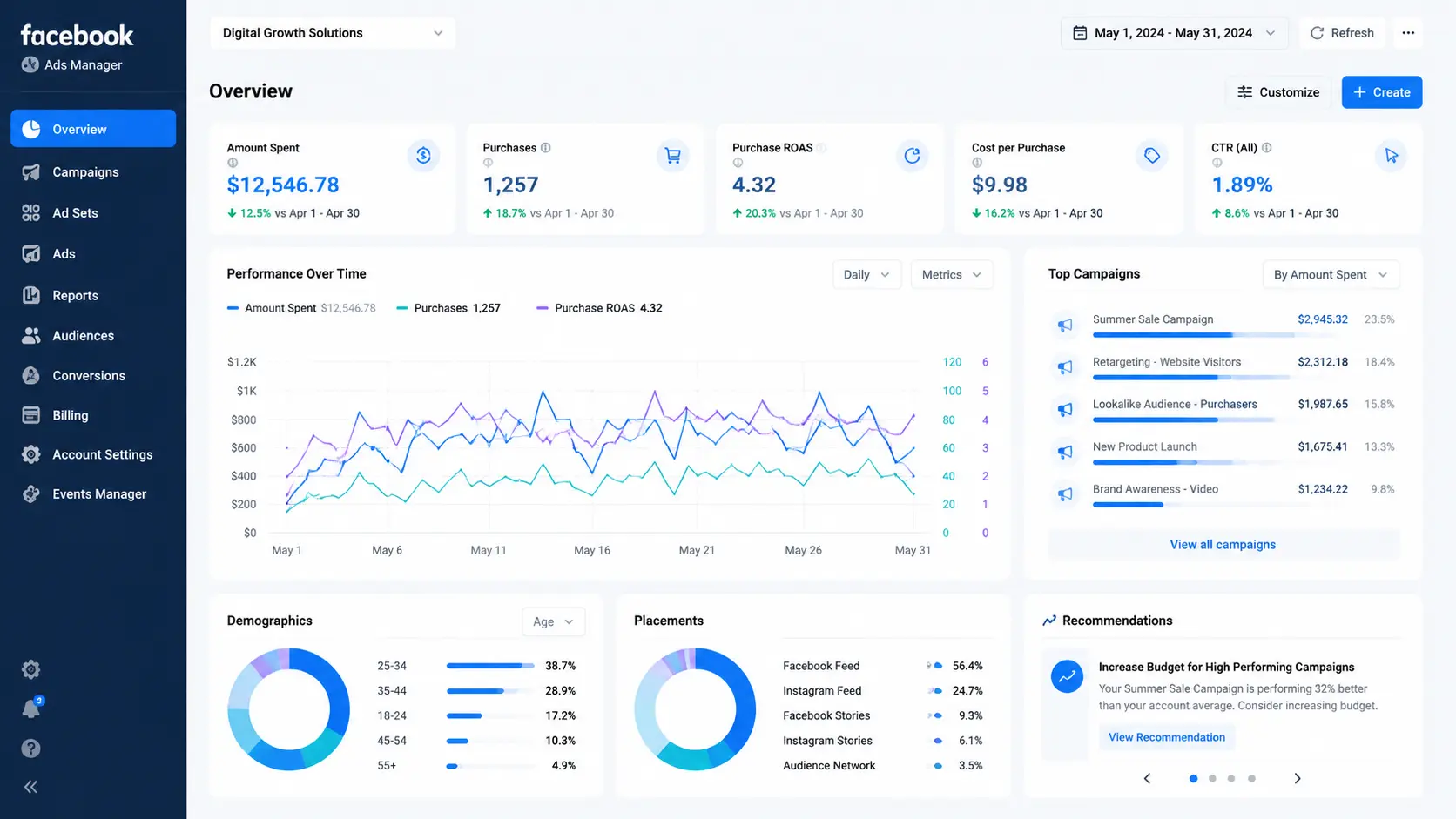
Cost benchmarks by metric
Most Facebook advertisers track costs using CPM, CPC, and CPA. CPM is cost per thousand impressions. CPC is cost per click. CPA is cost per acquisition or conversion. Each metric serves different planning purposes.
In 2026, average CPM on Facebook ranges from eight to fifteen dollars for broad US audiences. Competitive industries like finance, insurance, and B2B software see CPMs of fifteen to thirty dollars or higher. Less competitive consumer categories may see CPMs under eight dollars. CPC averages around one to two dollars for link clicks, but varies widely by audience and creative.
Factors that increase costs
Audience competition is the primary cost driver. When many advertisers target the same audience, auction prices rise. Audiences defined by high-value behaviors like purchasing insurance or investing attract premium pricing because the underlying customer value justifies higher acquisition costs.
Ad quality affects costs through Meta's relevance diagnostics. Ads with low engagement rates, negative feedback, or poor landing page experiences pay more to reach the same audience. The platform optimizes for user experience, and penalizing low-quality ads is part of that optimization.
Seasonal demand creates predictable cost spikes. Retail advertising costs increase during Q4 holiday periods. Tax services see higher costs approaching filing deadlines. Planning campaigns around these patterns helps avoid unnecessary premium pricing.
How to reduce costs
Improve creative quality before expanding budget. Higher engagement rates reduce effective CPM because the platform rewards ads users respond to positively. Test multiple creative variants and shift spend to top performers rather than running mediocre ads at higher volume.
Refine audience targeting to reduce waste. Broad targeting often delivers lower CPMs but may reach users with low purchase intent. Narrow targeting costs more per impression but can deliver lower cost per acquisition. Test different audience constructions to find the efficiency sweet spot for your product.
Use campaign budget optimization to let the algorithm distribute spend to best-performing ad sets. Manual budget allocation across many ad sets often creates inefficiencies where some sets are underfunded while others waste spend on marginal performance.
Budget planning framework
Start with your target cost per acquisition and work backward. If you can afford to spend fifty dollars to acquire a customer worth two hundred dollars, and your conversion rate from click to purchase is two percent, you can afford to pay one dollar per click or fifty dollars per thousand impressions at one percent click-through rate. These calculations set realistic expectations for what your budget can achieve.
Build in contingency for testing. New campaigns rarely hit efficiency targets immediately. Plan for an initial period of higher costs while you identify winning audiences and creative. Efficiency improves as you learn what works.
Comparing Facebook to other platforms
Facebook costs generally sit between Google search advertising, which has higher intent and higher costs, and display advertising, which has lower intent and lower costs. TikTok and Instagram Reels can deliver lower CPMs for video content but may have different audience compositions. YouTube costs vary by format with TrueView typically delivering mid-range CPMs.
Platform selection should match your audience and objective, not just cost minimization. A cheaper audience that never converts is more expensive than a premium audience that purchases. Evaluate platforms on cost per outcome, not just cost per impression.
Practical next steps
Benchmark your current costs against industry averages to understand where you stand. If your CPMs are significantly above average, investigate creative quality, audience overlap, and landing page experience. If costs are in range but conversion rates are low, focus on offer and landing page optimization rather than advertising mechanics.
Facebook ad costs will continue evolving as competition, platform policies, and user behavior change. Teams that monitor performance regularly, test methodically, and optimize based on data will maintain efficiency regardless of market conditions.
How to apply this guide in makeads
Use this guide as a practical checkpoint for planning AI UGC videos, comparing creative angles, and deciding which parts of your workflow should be scripted, generated, reviewed, localized, and tested first.
The most useful next step is to translate the advice into one production brief: define the audience, the opening hook, the proof moment, the actor style, subtitle requirements, and the metric you will use to decide whether a video variant is worth scaling.
Related focus areas for this topic include Facebook Ads, Paid Social, Ad Costs, Marketing Budget. If you are building a campaign library, connect this guide with your pricing assumptions, platform policy checks, and localization plan before creating the final export.