
AI Talking Avatar Creator: Complete Guide to Digital Presenters
Learn how to create AI talking avatars for marketing, training, and communications. Compare platforms, understand pricing, and master best practices for realistic digital presenters.
AI talking avatar creators have transformed video production by enabling anyone to generate professional presenter videos without cameras, actors, or studios. Understanding how these tools work and how to use them effectively opens new possibilities for marketing, training, and communications at scale.
How AI talking avatars work
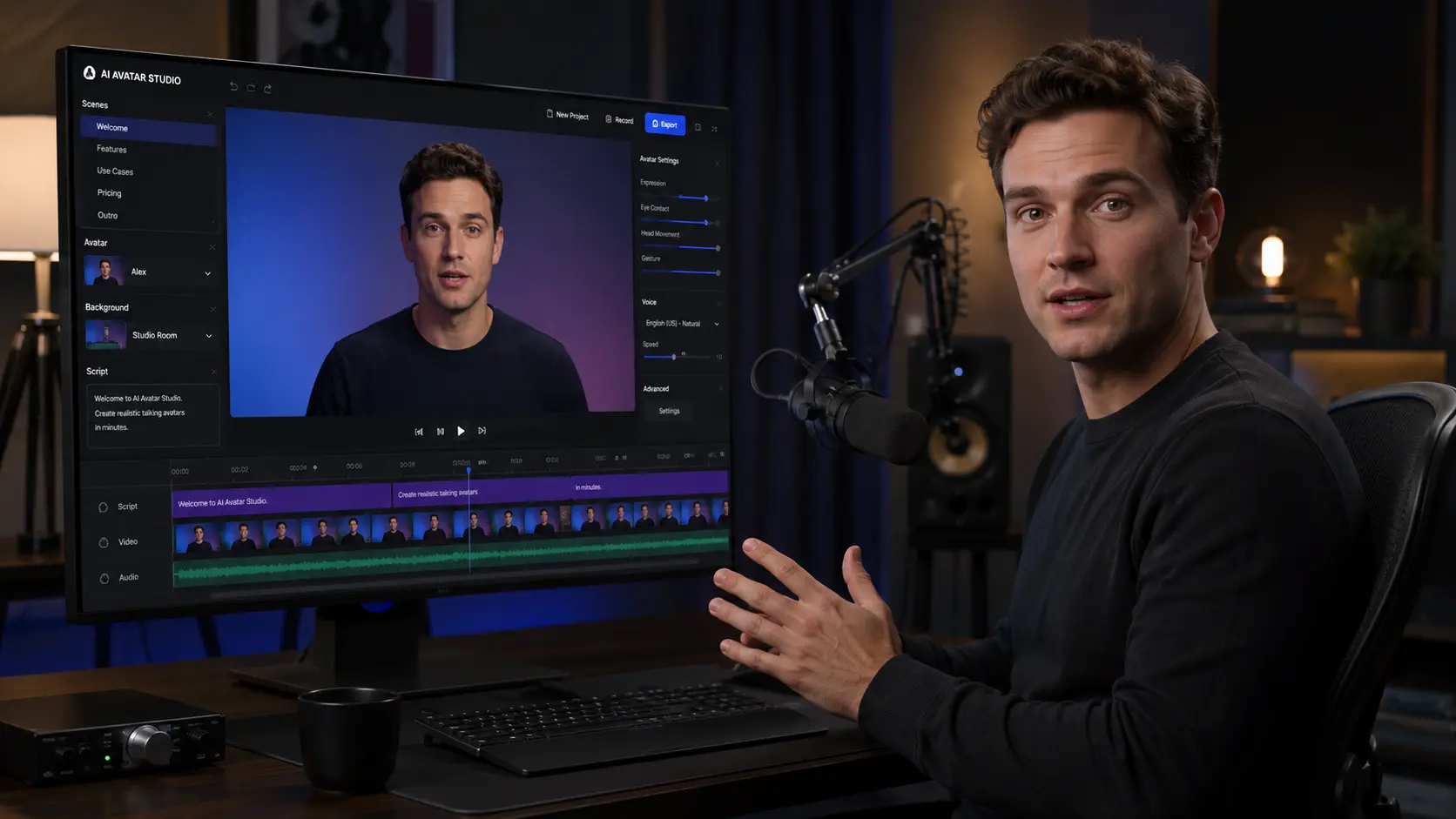
AI talking avatar systems combine several technologies. Text-to-speech generates natural-sounding voice from written scripts. Facial animation synchronizes lip movements to speech. Neural rendering creates realistic facial expressions and head movements. The result is video of a digital person speaking your content with natural mannerisms.
Modern systems achieve impressive realism. Early AI avatars suffered from uncanny valley effects, stiff movements, and obvious artificiality. Current generation technology handles subtle expressions, appropriate eye contact, and natural pauses. High-quality outputs are increasingly difficult to distinguish from real video footage.
Choosing an AI avatar platform
Several platforms offer AI talking avatar creation. HeyGen provides broad avatar selection with strong multilingual support. Synthesia targets enterprise use with corporate presenter aesthetics. D-ID specializes in animating photos into talking videos. makeads integrates avatar creation with broader video production tools. Each platform has distinct strengths suited to different use cases.
Evaluate platforms on output quality, avatar diversity, voice options, language support, and pricing. Quality is subjective but crucial: poor lip sync or unnatural expressions undermine credibility. Test multiple platforms with identical scripts before committing. The best platform produces acceptable results with minimal iteration.
Creating effective avatar videos
Script quality determines output quality. Write for spoken delivery, not written prose. Use short sentences and conversational language. Read your script aloud before generating; if it sounds awkward in your voice, it will sound awkward in an AI voice. Include natural pauses and emphasize key points through sentence structure rather than assuming the AI will add emphasis.
Avatar selection affects perceived authenticity. Match the presenter to your audience and message. A formal corporate announcement needs professional presentation. A consumer product review feels more authentic with casual, peer-to-peer delivery. Consider background choice as well: plain backgrounds suggest studio settings, while realistic environments feel more natural.
Use cases for AI talking avatars
Marketing teams use AI avatars for ad creative at scale, product demonstrations, and localized content. Training teams create consistent instructional videos without scheduling instructors. Sales teams generate personalized outreach videos. Internal communications produce leadership messages without coordinating executive schedules.
The technology works best for structured content with clear scripts. Explainer videos, product overviews, and instructional content are ideal. Less structured formats like spontaneous reactions, comedy, or emotionally complex narratives still benefit from human performers who can improvise and add subtle expressive layers.
Pricing models
Most platforms use credit-based or subscription models. Credits typically correspond to video duration: one credit might generate one minute of avatar video. Subscriptions bundle monthly credit allocations with platform access. Individual creator plans range from twenty to fifty dollars monthly. Team plans with higher volume cost one hundred to three hundred dollars monthly.
Calculate effective cost per final video. If you need three generations to get one usable result, your effective cost triples. Platforms with better prompt adherence and preview features reduce this waste and deliver better per-video economics.
Best practices for realistic results
Keep scripts concise. Longer scripts increase the chance of awkward phrasing or unnatural rhythm. Break complex content into shorter segments that can be combined in editing. Use consistent pacing throughout the script to avoid jarring speed changes.
Preview before final generation. Many platforms offer quick previews that show approximate timing and delivery. Use these to catch script problems before committing full generation credits. Iterate on scripts based on preview feedback for more efficient production.
Limitations to understand
Current AI avatars cannot hold objects, interact with physical environments, or perform complex movements. They speak to camera within a bounded frame. Emotional range is limited compared to human performers. Nuanced performances requiring subtle timing, irony, or complex emotional shifts remain challenging.
Understand these constraints when planning content. Structure scripts around what the technology does well. For content requiring emotional sophistication or physical interaction, consider using AI generation for structural elements and human performers for critical moments.
Getting started
Choose a single use case and small volume to begin. Test two or three platforms with identical scripts to compare quality, speed, and workflow fit. Evaluate not just output quality but editing tools, preview capabilities, and export flexibility. The best platform for your team produces acceptable quality with minimal iteration.
AI talking avatar creation is now a practical tool for video content at scale. Teams that invest in understanding the technology, writing appropriate scripts, and selecting matching avatars can produce professional video content faster and more efficiently than traditional production allows.
How to apply this guide in makeads
Use this guide as a practical checkpoint for planning AI UGC videos, comparing creative angles, and deciding which parts of your workflow should be scripted, generated, reviewed, localized, and tested first.
The most useful next step is to translate the advice into one production brief: define the audience, the opening hook, the proof moment, the actor style, subtitle requirements, and the metric you will use to decide whether a video variant is worth scaling.
Related focus areas for this topic include AI Avatar, Talking Head, Video Generation, Digital Presenter. If you are building a campaign library, connect this guide with your pricing assumptions, platform policy checks, and localization plan before creating the final export.