
AI Marketing Campaign Generator: Automate Creative Strategy at Scale
A comprehensive guide to AI marketing campaign generators, covering how they work, when to use them, and how to integrate AI-generated campaign concepts into your creative production workflow.
AI marketing campaign generators have transformed how teams approach creative strategy and campaign ideation. Instead of starting every campaign from scratch, marketers can now use AI to generate initial concepts, hook variations, and messaging frameworks in minutes. This acceleration does not replace strategic thinking but amplifies it, allowing teams to explore more creative territory and test more hypotheses within the same time and budget constraints.
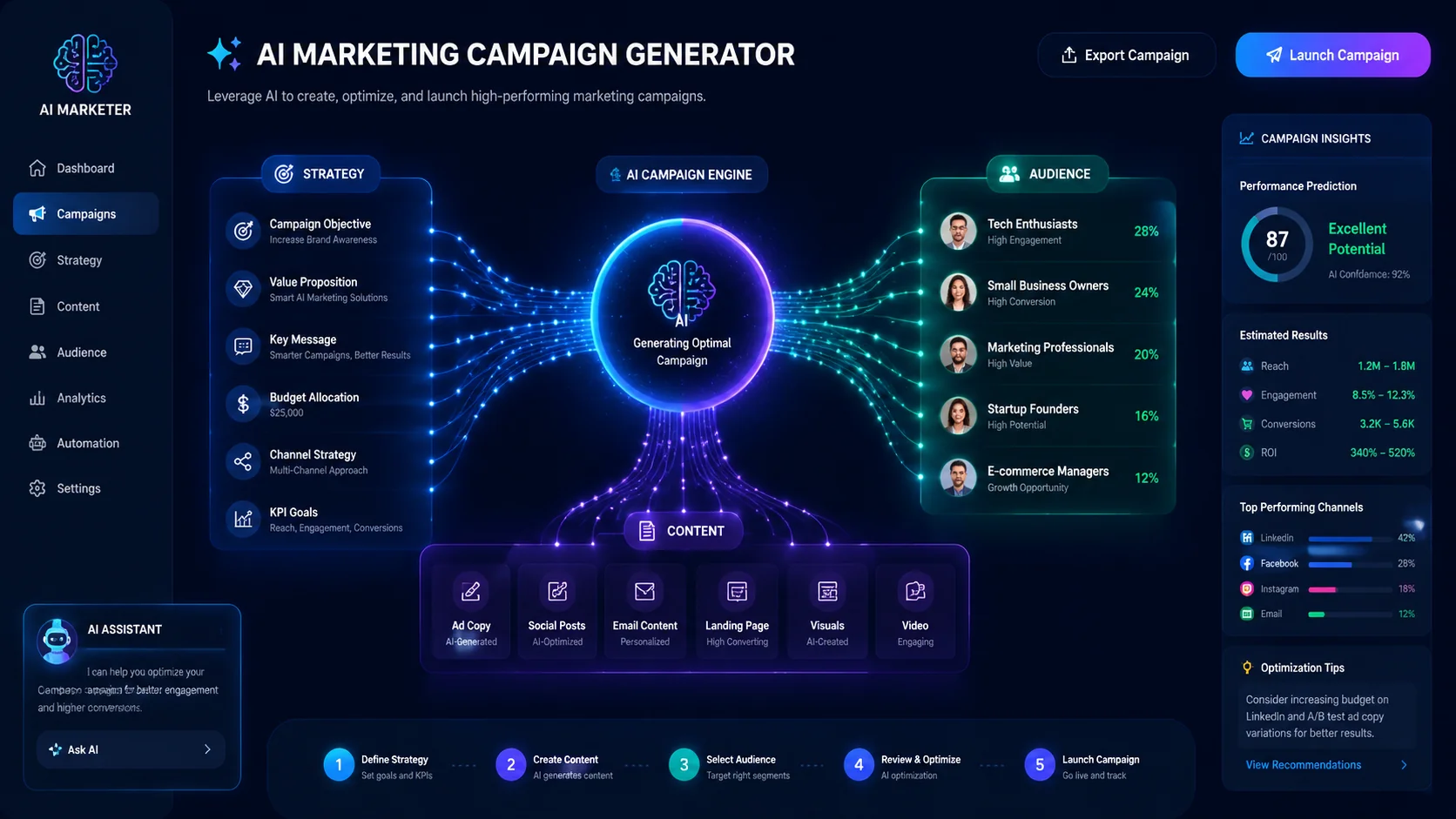
What AI campaign generators actually do
An AI marketing campaign generator takes inputs about your product, audience, and objectives, then produces structured campaign concepts including positioning statements, hook variations, key messages, and sometimes even complete scripts. The AI draws on patterns from successful campaigns across industries to propose concepts that follow proven structures while adapting to your specific context.
The output quality depends heavily on input quality. A vague description of "fitness app for busy professionals" produces generic concepts. A detailed brief specifying that "our fitness app offers fifteen-minute workouts for parents who exercise during lunch breaks, with a meal planning feature that auto-generates shopping lists" produces concepts that feel custom-developed. The AI amplifies the clarity you provide.
When to use AI campaign generation
AI campaign generators excel at the early ideation phase when you need to explore many directions quickly. Use them to generate initial concepts that human strategists can refine, to produce hook variations for creative testing, to adapt successful concepts across different audiences or markets, and to overcome creative blocks when the team feels stuck.
They are less effective for nuanced positioning that requires deep category expertise, for campaigns with complex regulatory constraints, for highly specific technical products where accuracy matters more than creative framing, and for brand-defining campaigns where the strategic stakes justify extensive human development. Use AI as an accelerator for appropriate contexts, not as a universal replacement for strategic thinking.
Integrating AI generation into your workflow
The most effective workflow treats AI-generated concepts as starting points, not finished work. Begin with a clear creative brief that specifies audience, problem, promise, and proof. Generate multiple concept directions using the AI tool. Review and select the most promising directions with human judgment. Refine selected concepts with strategic input. Develop the refined concepts into production-ready assets with your creative team.
This workflow captures the speed advantage of AI generation while preserving the strategic judgment that determines whether a concept will actually work. The AI produces volume; humans provide direction. The combination produces better results faster than either could achieve alone.
Evaluating AI-generated concepts
Apply the same evaluation criteria to AI-generated concepts that you would apply to human-developed work. Does the concept address a real audience pain? Is the promise credible given available proof? Does the hook create immediate engagement? Is the messaging consistent with brand voice? Does the concept differentiate from competitive alternatives?
Do not lower standards because the AI produced output quickly. Fast generation of mediocre concepts wastes the time saved in generation on downstream revision cycles. Better to generate many concepts and discard most of them than to accept concepts that do not meet your strategic standards.
Common pitfalls to avoid
The most common pitfall is accepting AI output without critical evaluation. The AI will produce plausible-sounding concepts regardless of whether they are strategically sound. Always validate AI-generated concepts against your understanding of the audience and market. Another pitfall is over-reliance on AI for all creative development, which can lead to generic output that lacks the distinctive perspective that drives breakthrough campaigns.
Also avoid using AI generators without first developing a clear strategic foundation. The AI cannot make strategic decisions for you. If your inputs are unclear, the output will be generic. Invest time in clarifying strategy before asking the AI to generate concepts, and the quality of output improves dramatically.
Measuring the impact of AI-assisted ideation
Track whether AI-assisted ideation improves your creative output and efficiency. Measure time from brief to production-ready concept with and without AI assistance. Track the volume of concepts explored per campaign. Compare performance of AI-informed campaigns against historically similar campaigns developed without AI. Survey your creative team on whether AI tools help or hinder their process.
The goal is not just faster concept development but better-performing campaigns. If AI generation produces more concepts in less time but the resulting campaigns underperform, the efficiency gain is illusory. Connect ideation acceleration to performance outcomes to understand the real value of AI campaign generation for your specific context.
How to apply this guide in makeads
Use this guide as a practical checkpoint for planning AI UGC videos, comparing creative angles, and deciding which parts of your workflow should be scripted, generated, reviewed, localized, and tested first.
The most useful next step is to translate the advice into one production brief: define the audience, the opening hook, the proof moment, the actor style, subtitle requirements, and the metric you will use to decide whether a video variant is worth scaling.
Related focus areas for this topic include AI Marketing, Campaign Generator, Marketing Automation, AI Tools. If you are building a campaign library, connect this guide with your pricing assumptions, platform policy checks, and localization plan before creating the final export.